India–EU Free Trade Agreement
28 Jan 2026
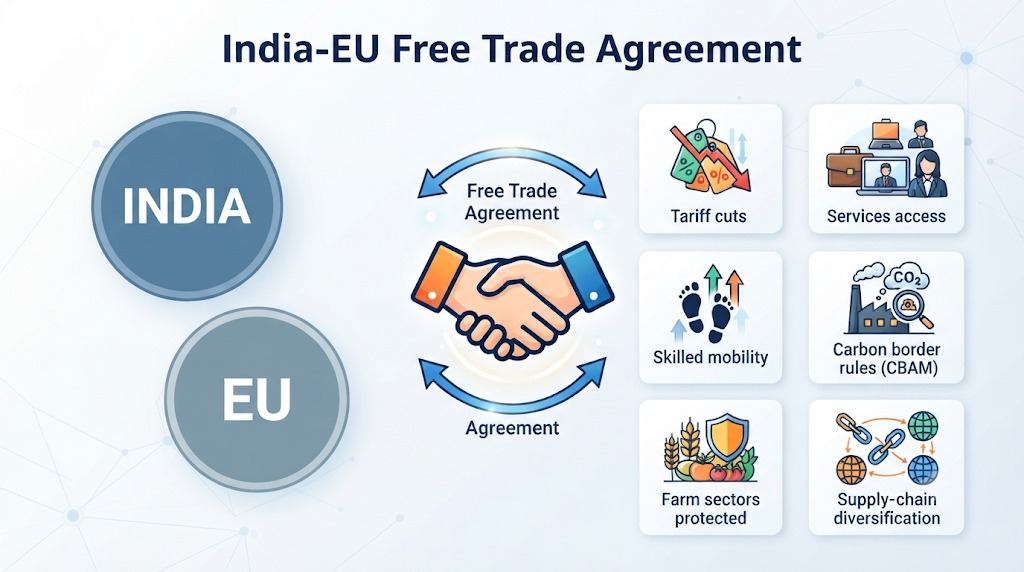
Consider the following statements regarding the India–EU Free Trade Agreement finalized at the 16th India–EU Summit: The EU has granted duty-free entry to over 99 percent of Indian exports by trade value. Sensitive domestic agricultural sectors such as dairy, cereals, and poultry are fully excluded from the agreement. European luxury automobiles will face an immediate, unconditional zero-duty import regime upon the pact's enactment. Which of the statements given above is/are correct?
- 1 only
- 1 and 2 only
- 2 and 3 only
- 1, 2 and 3
Practice questions are answered inside your account. Create a free account, or see what practice includes.
Consider the following statements regarding the mobility and services provisions under the India–EU Free Trade Agreement: India secured market access across 144 EU sub-sectors, including IT, finance, and education. The agreement introduces a mobility mechanism that streamlines visas for skilled workers and practitioners of Indian Traditional Medicine (AYUSH). Indian students covered under the pact receive zero post-study work rights in European member states. Which of the statements given above is/are correct?
- 1 and 2 only
- 2 and 3 only
- 1 and 3 only
- 1, 2 and 3
Practice questions are answered inside your account. Create a free account, or see what practice includes.
With reference to the implementation challenges of the India–EU Free Trade Agreement, which of the following issues presents a potential hurdle specifically for India’s generic pharmaceutical sector?
- Stringent sanitary and phytosanitary (SPS) regulations on agricultural goods
- European demands for heightened intellectual property protections such as data exclusivity
- Mandatory quotas on European luxury automobile imports
- Full exclusion of cereals and poultry from regional tariff cuts
Practice questions are answered inside your account. Create a free account, or see what practice includes.