SEBI’s IT Resilience Index (ITRI)
26 Aug 2026
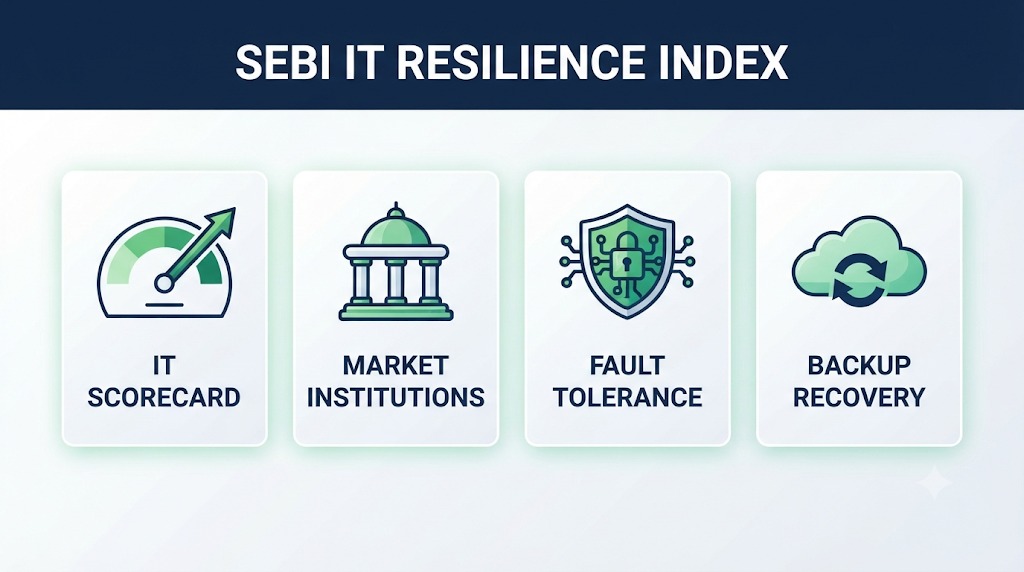
Consider the following statements regarding the IT Resilience Index (ITRI): It is introduced by the Reserve Bank of India (RBI) as a financial stability metric for commercial banks. It operates as a quantitative health scorecard focused on evaluating Market Infrastructure Institutions (MIIs). Which of the statements given above is/are correct?
- 1 only
- 2 only
- Both 1 and 2
- Neither 1 nor 2
Practice questions are answered inside your account. Create a free account, or see what practice includes.
In the risk-weighted nine-component framework of the IT Resilience Index (ITRI), which two pillars carry the highest individual weight of 20 percent each?
- Scalability and Reliability
- Availability and Cybersecurity
- Business Continuity and Scalability
- Cybersecurity and Business Continuity
Practice questions are answered inside your account. Create a free account, or see what practice includes.
What is the primary objective of the IT Resilience Index (ITRI) introduced by SEBI?
- To determine the capital adequacy ratio of commercial and cooperative banks
- To evaluate the profitability and revenue-generation capacity of stock exchanges
- To determine if primary digital networks supporting trading and settlement can endure operational shocks and cyberattacks
- To monitor foreign institutional investor inflows and outflows in real time
Practice questions are answered inside your account. Create a free account, or see what practice includes.
With reference to the IT Resilience Index (ITRI), consider the following statements: It marks a shift from traditional qualitative reviews to a concrete numerical score assessing real-time operational capability. It includes a mandatory Early Warning Mechanism (EWS) for automated live monitoring prior to service interruptions. Which of the statements given above is/are correct?
- 1 only
- 2 only
- Both 1 and 2
- Neither 1 nor 2
Practice questions are answered inside your account. Create a free account, or see what practice includes.