Space Reactor 1 (SR-1) Freedom Spacecraft
25 Mar 2026
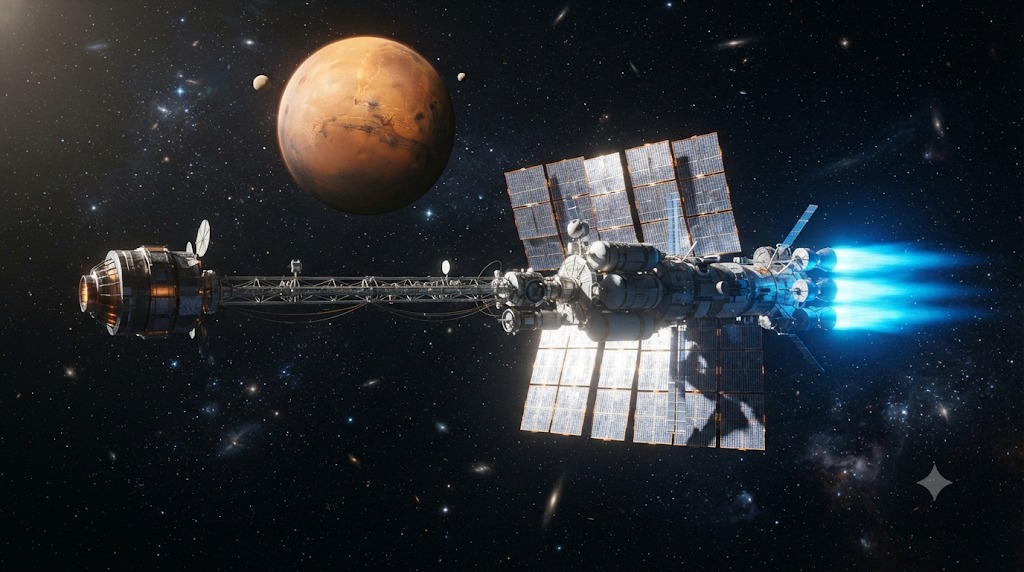
Consider the following statements regarding the Space Reactor 1 (SR-1) Freedom spacecraft: It is designed to be the first interplanetary vehicle driven by a nuclear fission reactor using Nuclear Electric Propulsion (NEP). Its launch is scheduled for December 2028, marking the first U.S. space reactor deployment since SNAP-10A in 1965. Which of the statements given above is/are correct?
- 1 only
- 2 only
- Both 1 and 2
- Neither 1 nor 2
Practice questions are answered inside your account. Create a free account, or see what practice includes.
What is the primary purpose of the Skyfall payload transported by the SR-1 Freedom spacecraft?
- To establish a communication relay station in Martian orbit
- To deploy a robotic helicopter fleet to search for water ice and prospective human landing sites on Mars
- To test atmospheric entry shields during a high-speed descent to the Martian surface
- To mine subsurface minerals using autonomous excavation rovers
Practice questions are answered inside your account. Create a free account, or see what practice includes.
In the context of the hardware design for the SR-1 Freedom spacecraft, which previously developed component was adapted for the vehicle?
- The Orion crew capsule designed for lunar orbit insertion
- The Power and Propulsion Element (PPE) initially built for the Lunar Gateway station
- The thermal protection heat shield used in the Mars Science Laboratory
- The upper-stage hydrogen fuel tank from the Artemis Space Launch System
Practice questions are answered inside your account. Create a free account, or see what practice includes.
Why is the deployment of a nuclear fission reactor on the SR-1 Freedom spacecraft considered a significant technological shift for deep-space exploration?
- It completely eliminates the need for any radioisotope thermoelectric generators on future probes.
- It provides a steady, high-capacity energy supply independent of solar illumination, enabling operations during Martian dust storms.
- It allows the spacecraft to achieve faster-than-light communication speeds with Earth.
- It replaces chemical rockets entirely for all planetary ascents and descents.
Practice questions are answered inside your account. Create a free account, or see what practice includes.