Hanging as a Constitutional Mode of Execution
20 Aug 2026
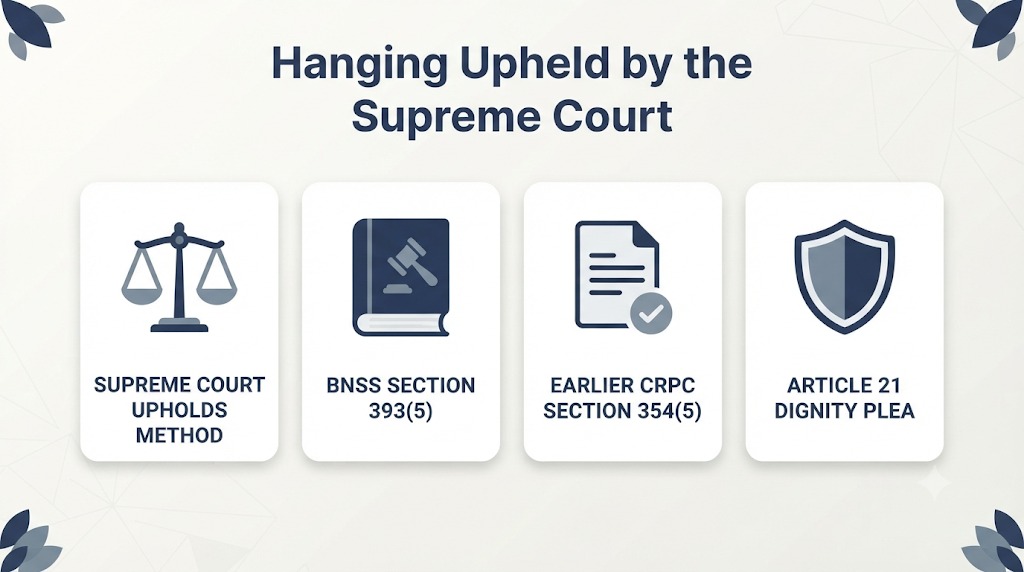
Consider the following statements regarding the legal framework of capital punishment in India: Section 393(5) of the Bharatiya Nagarik Suraksha Sanhita (BNSS), 2023 mandates execution by hanging until life is extinct. The mechanical objective of the long-drop hanging technique is to cause rapid expiration through fracture-dislocation specifically at the C2–C3 vertebrae. Which of the statements given above is/are correct?
- 1 only
- 2 only
- Both 1 and 2
- Neither 1 nor 2
Practice questions are answered inside your account. Create a free account, or see what practice includes.
With reference to the Supreme Court's stance on capital punishment via hanging, consider the following statements: The Supreme Court recently sustained the constitutional validity of hanging, rejecting arguments that it violates the right to dignity under Article 21. The ruling overruled the long-standing three-judge bench precedent established in Deena v. Union of India (1983). Which of the statements given above is/are correct?
- 1 only
- 2 only
- Both 1 and 2
- Neither 1 nor 2
Practice questions are answered inside your account. Create a free account, or see what practice includes.
Which of the following bodies or reports recommended modifying execution laws to provide lethal injection as an alternative choice for the convict?
- The 187th Law Commission Report (2003)
- The Justice Verma Committee
- The 262nd Law Commission Report
- The Malimath Committee on Criminal Justice Reforms
Practice questions are answered inside your account. Create a free account, or see what practice includes.
Under the existing legal framework governing military laws in India, which of the following statutory provisions permit court-martial death penalties to be executed by shooting (firing squad)?
- The Army Act of 1950, the Navy Act of 1957, and the Air Force Act of 1950
- The Bharatiya Nagarik Suraksha Sanhita (BNSS), 2023 only
- The Code of Criminal Procedure (CrPC), 1973
- The National Security Act, 1980
Practice questions are answered inside your account. Create a free account, or see what practice includes.
Which of the following best describes the Supreme Court's view on the status of Law Commission recommendations regarding the mode of execution?
- Law Commission findings are binding on Parliament and automatically amend statutory provisions.
- Law Commission findings are purely recommendatory and cannot override statutory enactments passed by Parliament.
- Law Commission recommendations hold equal weight to constitutional amendments.
- Law Commission reports have mandatory persuasive value that compels the executive to alter prison manuals immediately.
Practice questions are answered inside your account. Create a free account, or see what practice includes.