Disaster Victim Identification (DVI) Guidelines
6 Feb 2026
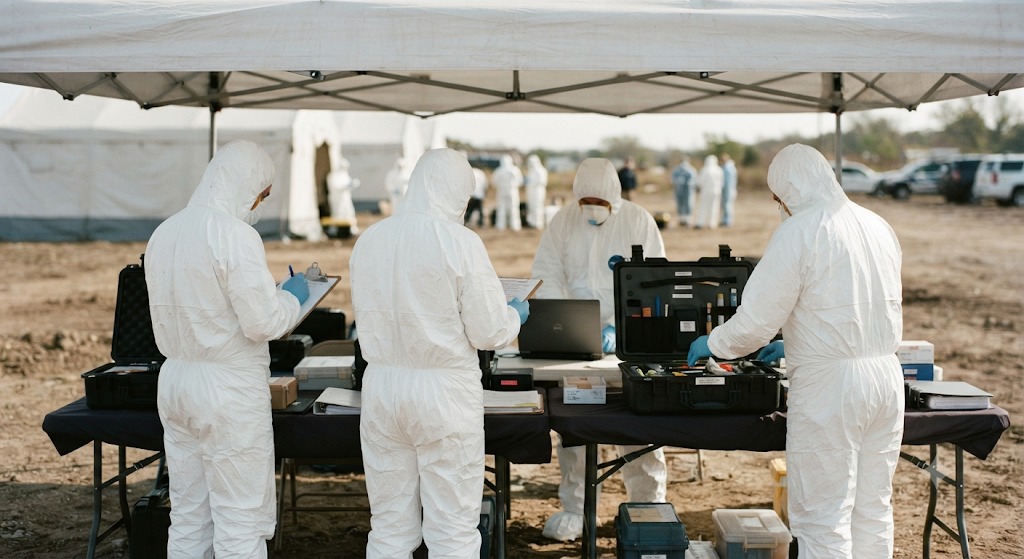
In the context of the national Disaster Victim Identification (DVI) guidelines, how are items such as ornaments, tattoos, and scars officially treated?
- Primary identifiers
- Secondary identifiers
- Digital biometrics
- Conclusive legal certificates
Practice questions are answered inside your account. Create a free account, or see what practice includes.
What is the recommended sequence of the four-stage Disaster Victim Identification (DVI) process outlined in the national guidelines?
- Post-mortem data collection -> Scene phase -> Ante-mortem data collection -> Reconciliation
- Scene phase -> Post-mortem data collection -> Ante-mortem data collection -> Reconciliation
- Ante-mortem data collection -> Scene phase -> Post-mortem data collection -> Reconciliation
- Scene phase -> Ante-mortem data collection -> Post-mortem data collection -> Reconciliation
Practice questions are answered inside your account. Create a free account, or see what practice includes.
Under the newly established Disaster Victim Identification (DVI) framework, which of the following are formally categorized as primary identifiers for deceased individuals?
- DNA profiling, forensic odontology, and fingerprints
- Fingerprints, tattoos, and dental records
- DNA profiling, personal ornaments, and scars
- Forensic anthropology, biometrics from mobile phones, and dental records
Practice questions are answered inside your account. Create a free account, or see what practice includes.
Consider the following statements regarding the newly introduced Disaster Victim Identification (DVI) Guidelines in India: The National Disaster Management Authority (NDMA) issued these guidelines with drafting support from the National Forensic Sciences University (NFSU). The framework aligns with the global best practices established by Interpol DVI. Which of the statements given above is/are correct?
- 1 only
- 2 only
- Both 1 and 2
- Neither 1 nor 2
Practice questions are answered inside your account. Create a free account, or see what practice includes.