The Paradox of Self-Reliance & the Assembly Trap
21 Sept 2026
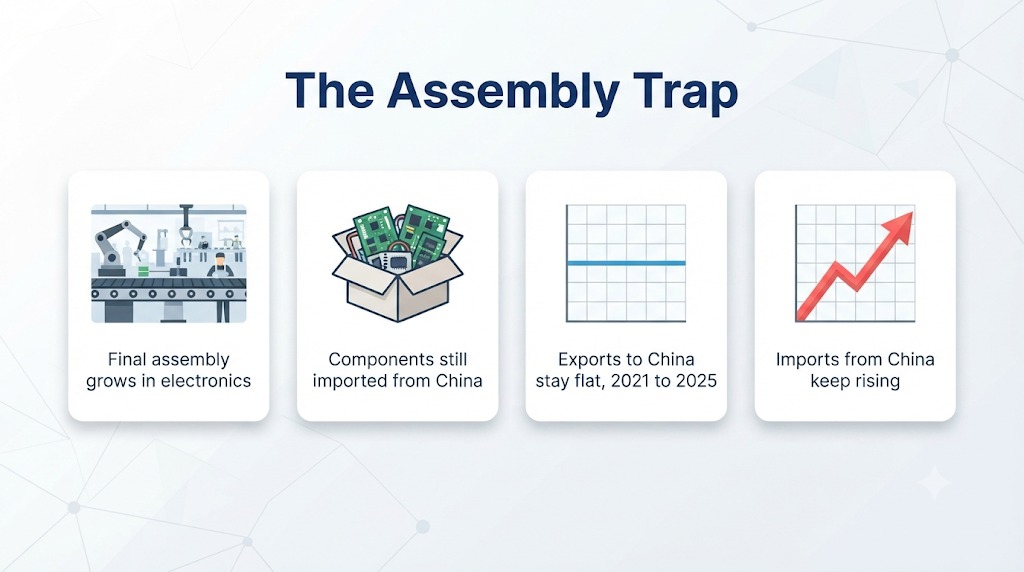
Consider the following statements regarding India-China trade dynamics between 2021 and 2025: Indian exports to China witnessed a sharp exponential growth, outpacing import growth. Intermediate goods constitute the vast majority of total imports from China. Finished consumer goods represent the largest share of imports from China, driving the bilateral trade deficit. Which of the statements given above is/are correct?
- 2 only
- 1 and 2 only
- 2 and 3 only
- 1, 2 and 3
Practice questions are answered inside your account. Create a free account, or see what practice includes.
The term 'Assembly Trap', often discussed in the context of industrial policy and international trade, refers to:
- A situation where domestic manufacturing relies excessively on basic screwdriver assembly, leading to increased demand for imported intermediate components and structural fragility.
- The legal restrictions imposed by international trade bodies that prevent developing nations from exporting fully assembled electronic goods.
- A deliberate protectionist tariff structure that penalizes foreign firms for setting up assembly lines within domestic special economic zones.
- The phenomenon where domestic value addition exceeds 80%, causing a sudden appreciation of the local currency and hurting export competitiveness.
Practice questions are answered inside your account. Create a free account, or see what practice includes.
With reference to the structural drivers of India's trade deficit in the electronics and manufacturing sectors, consider the following factors: Massive scale and state capital subsidies enjoyed by Chinese suppliers Nascent domestic capacity in printed circuit board assemblies (PCBAs) and semiconductor fabrication Incentive structures that historically rewarded final output volume and export turnover rather than domestic value addition Which of the above are identified as primary drivers of this structural trade imbalance?
- 1 and 2 only
- 2 and 3 only
- 1 and 3 only
- 1, 2 and 3
Practice questions are answered inside your account. Create a free account, or see what practice includes.