The Cretaceous Kraken↗
25 Apr 2026
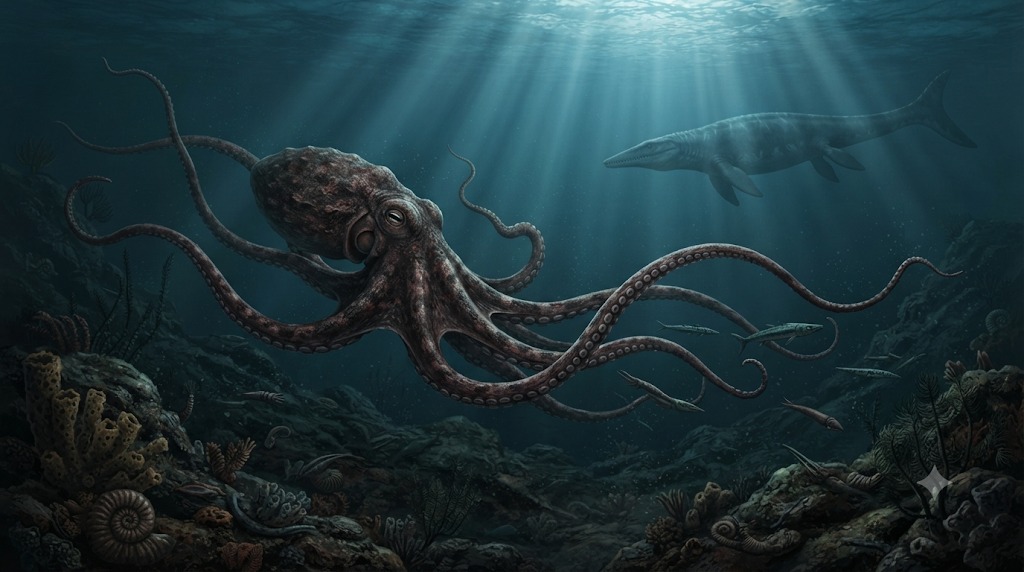
Consider the following statements regarding the prehistoric octopus species Nanaimoteuthis haggarti: It inhabited the oceans during the Cretaceous Period, roughly 86 to 72 million years ago. It shared its ecological apex predator status exclusively with modern-day cetaceans like whales and sharks. Fossilized beak evidence indicates advanced intelligence and behavioral lateralization. Which of the statements given above are correct?
- 1 and 2 only
- 1 and 3 only
- 2 and 3 only
- 1, 2, and 3
Practice questions are answered inside your account. Create a free account, or see what practice includes.
With reference to the physical characteristics and anatomy of Nanaimoteuthis haggarti, which of the following statements is correct?
- It relied entirely on soft tentacles without any hard mouthparts to capture prey.
- Its maximum recorded length of 61 feet makes it smaller than the contemporary giant squid.
- Scientists postulate the presence of swimming fins based on the morphology of its fossilized beaks.
- It lacked any predatory role on the seafloor and subsisted purely on microscopic plankton.
Practice questions are answered inside your account. Create a free account, or see what practice includes.
What is the significance of the asymmetrical wear patterns found on the fossilized beaks of Nanaimoteuthis haggarti?
- They indicate dietary specialization exclusively restricted to soft-bodied fish.
- They suggest handedness or lateralized conduct pointing toward advanced, adaptable behavior.
- They demonstrate damage sustained exclusively from battles with mosasaurs.
- They are routine growth rings used for precise chronological dating of the Cretaceous period.
Practice questions are answered inside your account. Create a free account, or see what practice includes.
Which of the following anatomical features enabled Nanaimoteuthis haggarti to function effectively as an apex predator capable of shattering shells and bones?
- A calcareous exoskeleton similar to modern crustaceans
- Highly durable, hard beaks composed of chitin
- Venomous harpoon-like radula teeth
- A bony vertebrate jaw structure
Practice questions are answered inside your account. Create a free account, or see what practice includes.