Urban Co-operative Banks (UCBs)
27 Jan 2026
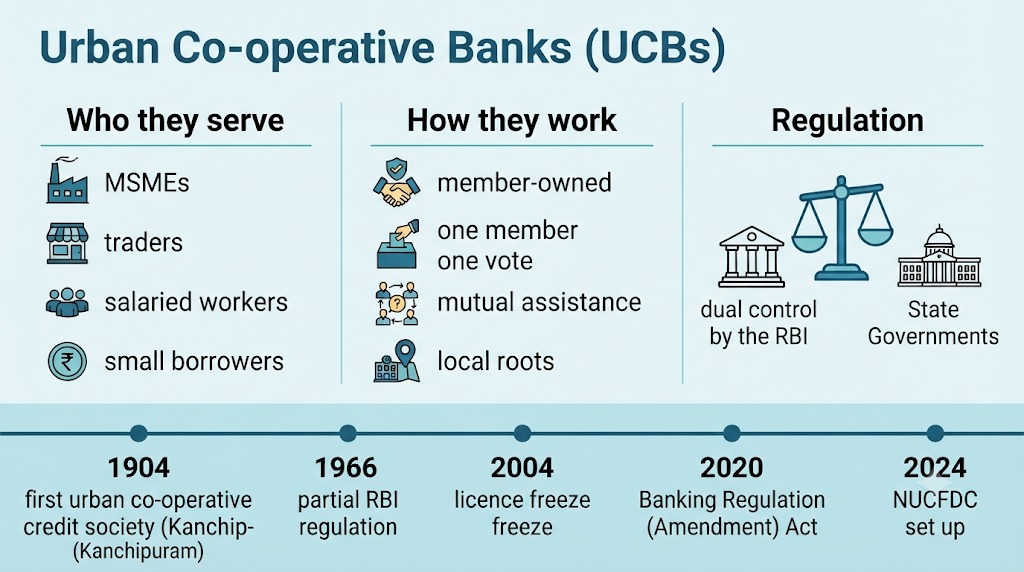
- 1904
First Credit Society
- 1966
RBI Regulation
- 2004
Licensing Freeze
- 2020
Amendment Act
- 2024
NUCFDC Created
Consider the following statements regarding Urban Co-operative Banks (UCBs) in India: They operate on core co-operative principles such as the 'one member, one vote' rule and democratic management. The first urban co-operative credit society in India was established in Kanchipuram in 1904. They have been under the exclusive regulatory control of the Reserve Bank of India since their inception. Which of the statements given above is/are correct?
- 1 only
- 1 and 2 only
- 2 and 3 only
- 1, 2 and 3
Practice questions are answered inside your account. Create a free account, or see what practice includes.
What primary reason prompted the Reserve Bank of India (RBI) to freeze the issuance of new Urban Co-operative Bank (UCB) licenses in 2004?
- Severe depletion of foreign exchange reserves
- Widespread administrative lapses resulting from unchecked licensing during the 1990s
- The complete digitalization of traditional joint-stock banks
- A legislative mandate dissolving all cooperative institutions in urban areas
Practice questions are answered inside your account. Create a free account, or see what practice includes.
Which of the following best describes the historical origin of the urban co-operative credit movement in India?
- It was entirely indigenous, originating from ancient temple trusts in South India.
- It was inspired by European co-operative models from Germany and Britain, leading to the first society in 1904.
- It was initiated in the mid-1950s under the first five-year plan as a substitute for rural banks.
- It began as a post-independence initiative to nationalize urban moneylenders.
Practice questions are answered inside your account. Create a free account, or see what practice includes.
What is considered a significant role or characteristic of Urban Co-operative Banks (UCBs) in the Indian financial system?
- They exclusively cater to large corporate conglomerates and multinational export houses.
- They serve as a vital link connecting informal money markets with formal banking networks for smaller borrowers.
- They charge significantly higher interest rates than standard microfinance institutions.
- They operate purely on commercial profit-maximization principles without community involvement.
Practice questions are answered inside your account. Create a free account, or see what practice includes.