The Chandrayaan-2 Dual Frequency Synthetic Aperture Radar (DFSAR)
29 May 2026
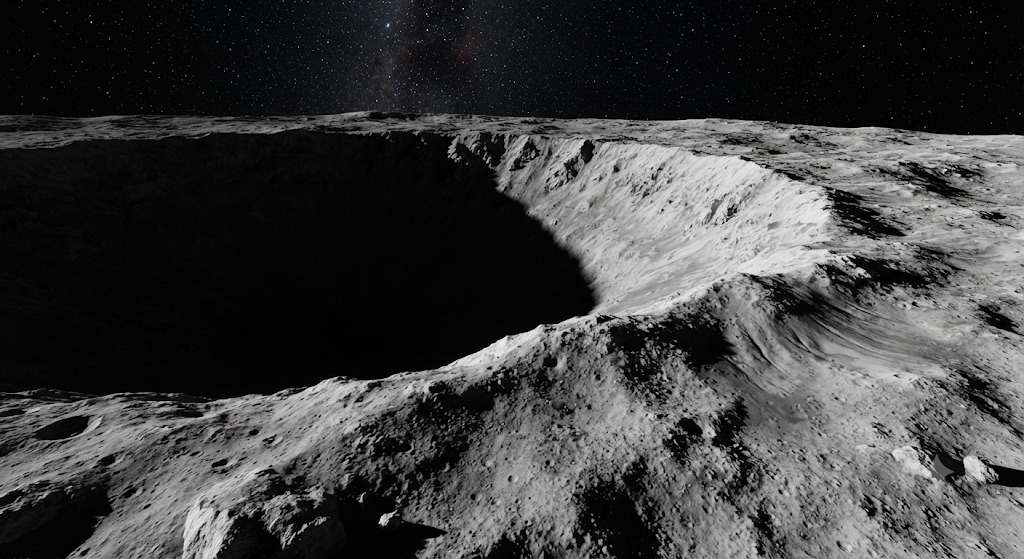
Consider the following statements regarding the Dual Frequency Synthetic Aperture Radar (DFSAR) onboard Chandrayaan-2: It is the first fully polarimetric Synthetic Aperture Radar sent to explore the Moon. It operates using optical sensors that rely entirely on direct sunlight illumination of lunar craters. It utilizes both L-band and S-band microwave frequencies to penetrate the lunar regolith. Which of the statements given above are correct?
- 1 and 2 only
- 1 and 3 only
- 2 and 3 only
- 1, 2 and 3
Practice questions are answered inside your account. Create a free account, or see what practice includes.
In the context of identifying underground water-ice using the DFSAR instrument, how does the radar distinguish genuine ice from rocky landscapes that produce chaotic signal scattering?
- By identifying areas where a high Circular Polarization Ratio (CPR) coincides with an ultra-low Degree of Polarization (DOP)
- By measuring thermal infrared emissions radiating directly from permanently shadowed crater floors
- By detecting sudden drops in microwave signal penetration caused by surface regolith density
- By observing optical shadow boundaries inside doubly shadowed craters during lunar summer
Practice questions are answered inside your account. Create a free account, or see what practice includes.
Consider the following statements regarding recent findings made by researchers using Chandrayaan-2 DFSAR data in the lunar South Polar Region: Subsurface water-ice indicators were verified beneath the bases of four separate doubly shadowed craters. Solid indicators of underground ice were detected within a compact crater located inside the broader Faustini crater complex. The discovered ice deposits were linked to crater depressions maintaining temperatures near 25K. Which of the statements given above are correct?
- 1 and 2 only
- 2 and 3 only
- 1 and 3 only
- 1, 2 and 3
Practice questions are answered inside your account. Create a free account, or see what practice includes.
Which of the following best describes the primary objective of the Dual Frequency Synthetic Aperture Radar (DFSAR) on Chandrayaan-2?
- Mapping the lunar gravitational field to detect mass concentrations across maria and highlands
- Examining lunar surface features, terrain texture, and underground material makeup with a focus on volatiles like water-ice
- Measuring the solar wind interaction and exospheric density directly above the lunar equator
- Conducting high-resolution optical photography of historical landing sites
Practice questions are answered inside your account. Create a free account, or see what practice includes.