Managing Coexistence in Human-Animal Conflict Zones↗
13 May 2026
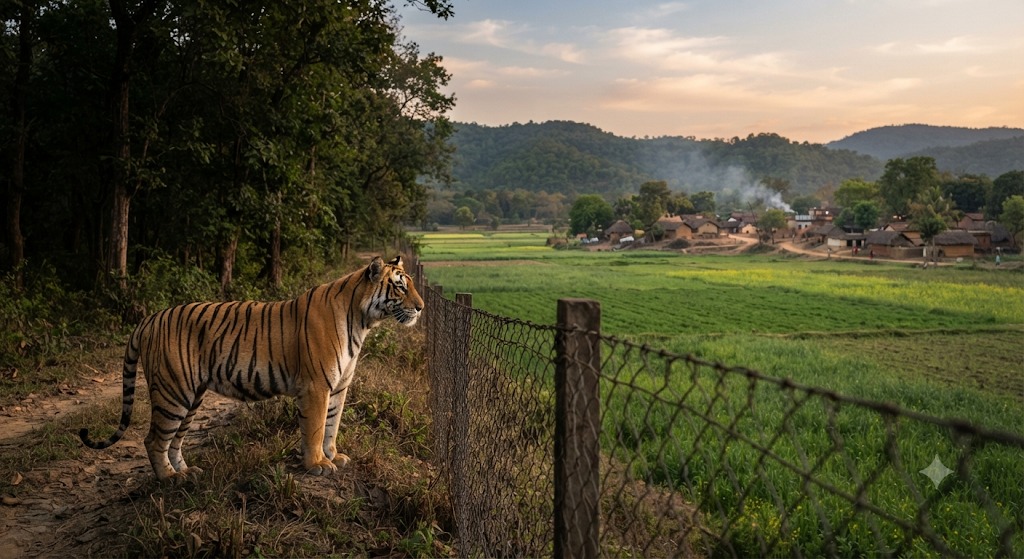
Consider the following statements regarding human-wildlife conflict statistics in India: Encounters with elephants claim approximately 500 human lives annually, with concentration in Odisha, West Bengal, and Assam. Karnataka registered 53 human fatalities due to human-wildlife conflict during the 2025-26 fiscal year. India documented 166 tiger fatalities in 2025, marking the lowest yearly total since 1973. Which of the statements given above are correct?
- 1 and 2 only
- 2 and 3 only
- 1 and 3 only
- 1, 2 and 3
Practice questions are answered inside your account. Create a free account, or see what practice includes.
With reference to the drivers behind the increase in human-animal conflict, consider the following examples: Infrastructure expansion in the Western Ghats disrupting elephant corridors. Leopards in Maharashtra adjusting to sugarcane fields near human habitations. Invasive weeds choking out native grasses in Bandipur, compelling herbivores to seek food in nearby farms. Which of the above correctly match the driver to its corresponding regional manifestation?
- 1 and 2 only
- 2 and 3 only
- 1 and 3 only
- 1, 2 and 3
Practice questions are answered inside your account. Create a free account, or see what practice includes.
In the context of the proposed measures for managing human-wildlife coexistence, what is the primary purpose of prioritizing the eradication of invasive species and the revival of degraded grasslands?
- To expand agricultural land for marginal farmers
- To enhance natural fodder availability for herbivores
- To clear pathways exclusively for high-speed linear infrastructure projects
- To facilitate commercial timber extraction in reserve forests
Practice questions are answered inside your account. Create a free account, or see what practice includes.