Weaponisation of Space: The Emerging Arms Race in Earth’s Orbit
16 Sept 2026
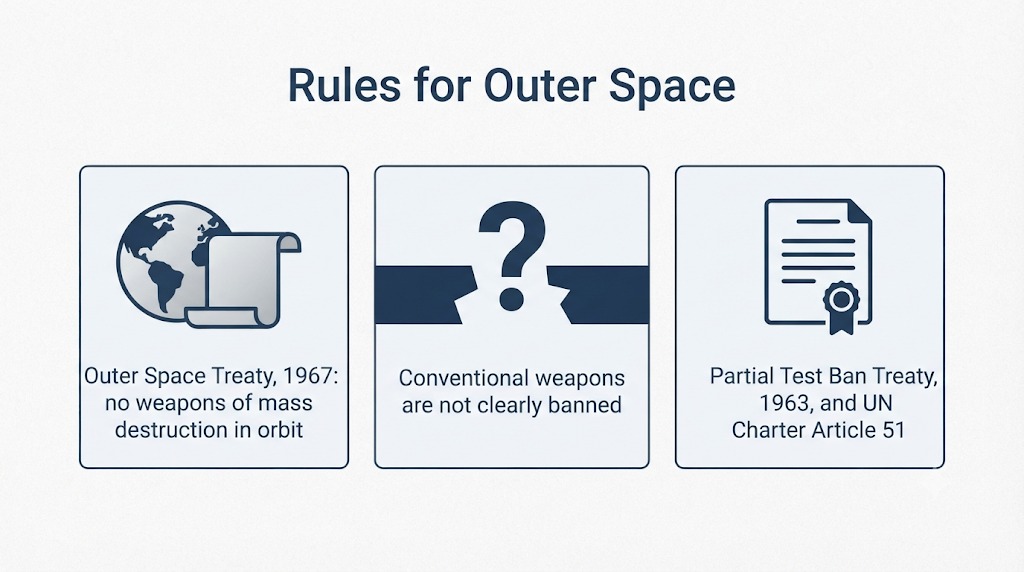
Consider the following statements regarding the legal frameworks governing outer space: The Outer Space Treaty of 1967 explicitly prohibits the placement of nuclear weapons in Earth's orbit. The Outer Space Treaty completely outlaws the deployment of conventional armaments, kinetic interceptors, and directed-energy weapons in outer space. The Moon Agreement of 1979 has been universally ratified by all major spacefaring nations. Which of the statements given above is/are correct?
- 1 only
- 1 and 2 only
- 2 and 3 only
- 1, 2 and 3
Practice questions are answered inside your account. Create a free account, or see what practice includes.
With reference to counterspace technologies and capabilities, the term 'co-orbital rendezvous and proximity operations' (RPO) refers to which of the following?
- Ground-launched kinetic interceptors designed to destroy low-Earth orbit satellites from the surface
- Ground-based laser and microwave setups intended to permanently blind optical sensors on reconnaissance satellites
- Agile inspector spacecraft capable of tracking, trailing, grasping, or physically incapacitating enemy satellites
- Spaceborne jammers and spoofers utilized to intercept and degrade uplink and downlink communications channels
Practice questions are answered inside your account. Create a free account, or see what practice includes.
Consider the following phenomena associated with space weaponisation: Generation of high-velocity fragments capable of triggering a chain reaction of satellite impacts Difficulty in distinguishing between satellite malfunctions and intentional cyber or kinetic attacks Disruption of critical civilian infrastructure such as financial transactions, aviation, and weather forecasting Which of the above are recognized concerns related to the weaponisation of space?
- 1 and 2 only
- 2 and 3 only
- 1 and 3 only
- 1, 2 and 3
Practice questions are answered inside your account. Create a free account, or see what practice includes.
The 'Dual-Use Technology Dilemma' in the context of outer space security primarily arises due to which of the following reasons?
- Space agencies rely on identical frequencies for both military reconnaissance and deep-space scientific research.
- Equipment designed for clearing debris, servicing satellites, and refuelling can easily be repurposed to capture or neutralise another nation's satellites.
- The Outer Space Treaty permits dual-use nuclear propulsion systems for interplanetary travel but bans them in Earth orbit.
- Commercial rocket launchers are routinely used by military forces without prior notification to international bodies.
Practice questions are answered inside your account. Create a free account, or see what practice includes.