The Ganges Soft-Shell Turtle↗
16 May 2026
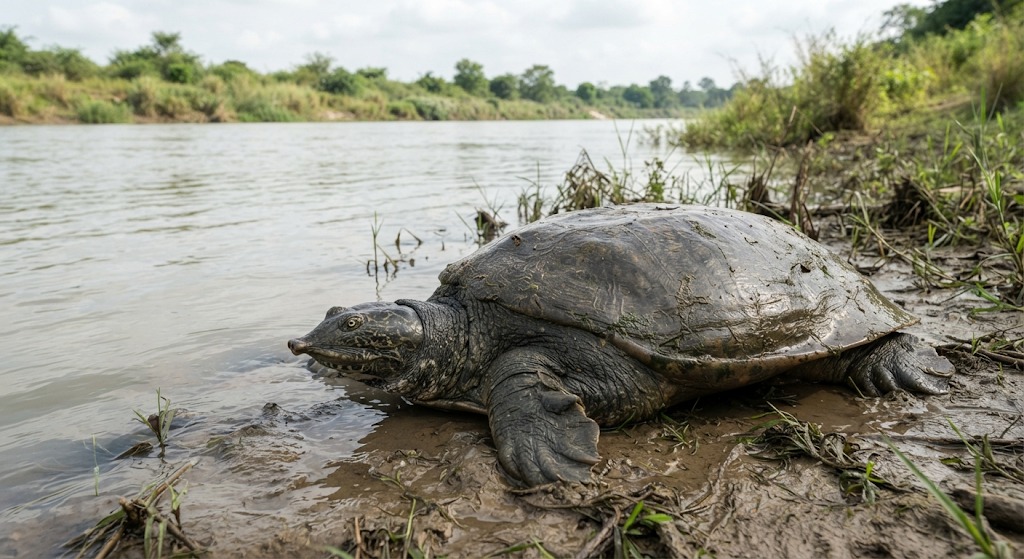
Consider the following statements regarding the Ganges soft-shell turtle (Nilssonia gangetica): It is primarily an apex predator and scavenger found in major river systems such as the Ganges, Brahmaputra, and Indus. Under the IUCN Red List, it is categorized as Critically Endangered. It possesses an elongated, tubular snout that functions as a snorkel for respiration while submerged. Which of the statements given above are correct?
- 1 and 2 only
- 1 and 3 only
- 2 and 3 only
- 1, 2 and 3
Practice questions are answered inside your account. Create a free account, or see what practice includes.
Under which schedule of the Wildlife (Protection) Act, 1972 is the Ganges soft-shell turtle (Nilssonia gangetica) protected in India?
- Schedule I
- Schedule III
- Schedule IV
- Schedule V
Practice questions are answered inside your account. Create a free account, or see what practice includes.
Which of the following physical characteristics helps distinguish the Ganges soft-shell turtle from other freshwater turtles?
- A rigid, highly domed bony carapace with prominent concentric growth rings
- Inverted-V streaks and black arrowhead-patterned markings on its olive-shaded head
- A complete absence of plastral callosities on its ventral structure
- A bright red-striped pattern along the margin of its leathery upper shell
Practice questions are answered inside your account. Create a free account, or see what practice includes.
With reference to the natural habitat and geographical distribution of the Ganges soft-shell turtle, consider the following rivers: Indus Narmada Mahanadi In which of the above-mentioned river basins within India is this species widely found?
- 1 only
- 1 and 2 only
- 2 and 3 only
- 1, 2 and 3
Practice questions are answered inside your account. Create a free account, or see what practice includes.
What is the primary function of the elongated, tubular snout found in the Ganges soft-shell turtle?
- It acts as a sensory organ to detect electrical fields of prey in murky water.
- It functions as a snorkel to allow respiration while remaining mostly submerged.
- It aids in filtering microscopic plankton from the river substrate.
- It is used exclusively to dig deep nesting burrows in rocky terrain.
Practice questions are answered inside your account. Create a free account, or see what practice includes.