National Household Travel Survey (NHTS)
6 Oct 2026
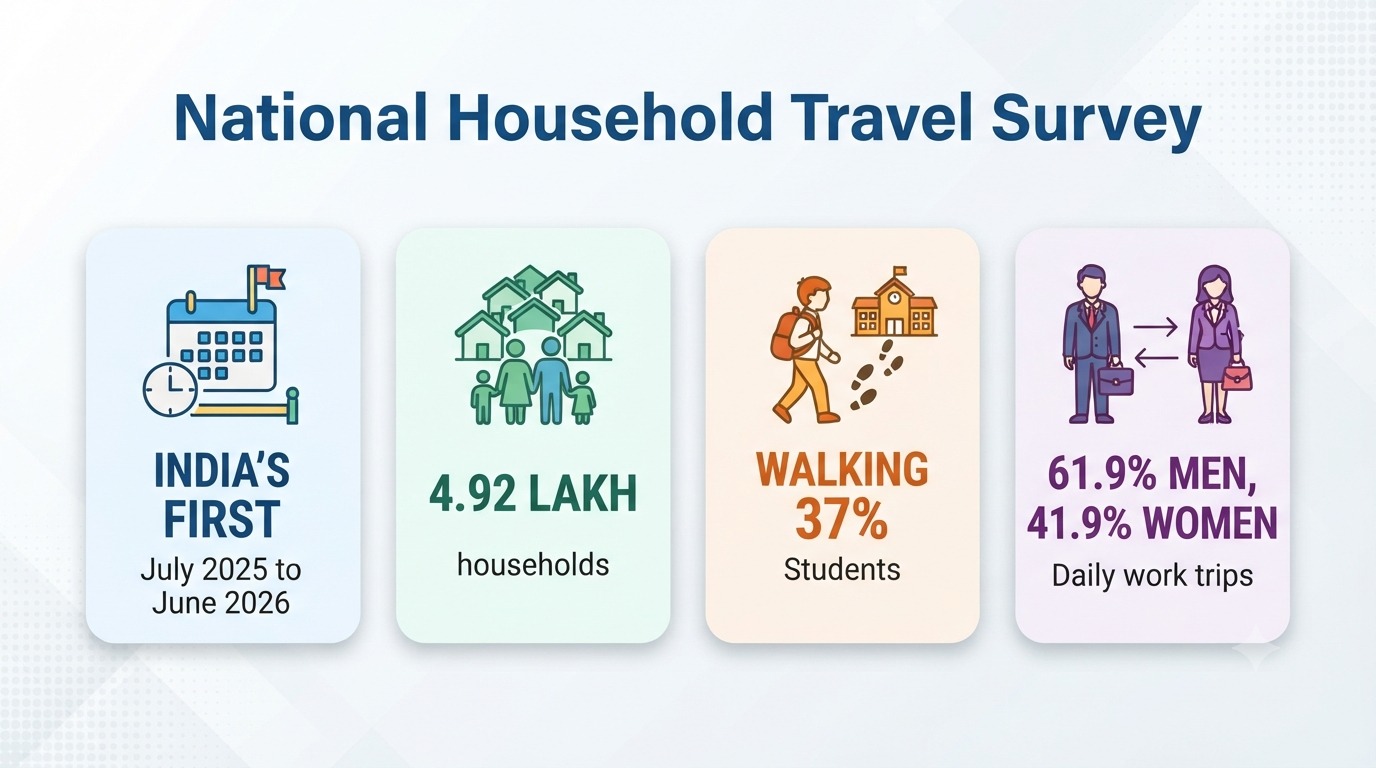
Consider the following statements regarding the National Household Travel Survey (NHTS): It is conducted by the National Statistics Office (NSO) under the Ministry of Statistics and Programme Implementation. The survey considers all trips regardless of distance, including those under 1 km. Which of the statements given above is/are correct?
- 1 only
- 2 only
- Both 1 and 2
- Neither 1 nor 2
Practice questions are answered inside your account. Create a free account, or see what practice includes.
According to the National Household Travel Survey, what is the largest mode of transport used by students to reach educational institutions?
- Buses
- Bicycles
- Walking
- Two-wheelers
Practice questions are answered inside your account. Create a free account, or see what practice includes.
Consider the following findings related to workforce mobility from the National Household Travel Survey: Urban worker mobility is lower than rural worker mobility for journeys to workplaces over 1 km. Two-wheelers are used as the main mode of transport by more than half of urban workers. Which of the statements given above is/are correct?
- 1 only
- 2 only
- Both 1 and 2
- Neither 1 nor 2
Practice questions are answered inside your account. Create a free account, or see what practice includes.
What is the primary purpose identified in the survey for household trips involving overnight stays?
- Tourism and leisure
- Business and professional work
- Religious, social, and communication purposes
- Education and training
Practice questions are answered inside your account. Create a free account, or see what practice includes.
Regarding the average duration and monthly expenditure on commutes as revealed by the National Household Travel Survey, which of the following is correct?
- On average, workers spend more time commuting than students do.
- Rural workers spend significantly more per month on commuting than urban workers.
- More than half of the students take longer than 30 minutes to reach their educational institutions.
- Daily trips for work are made by a higher percentage of female workers than male workers.
Practice questions are answered inside your account. Create a free account, or see what practice includes.