The No Cloning Theorem
4 Apr 2026
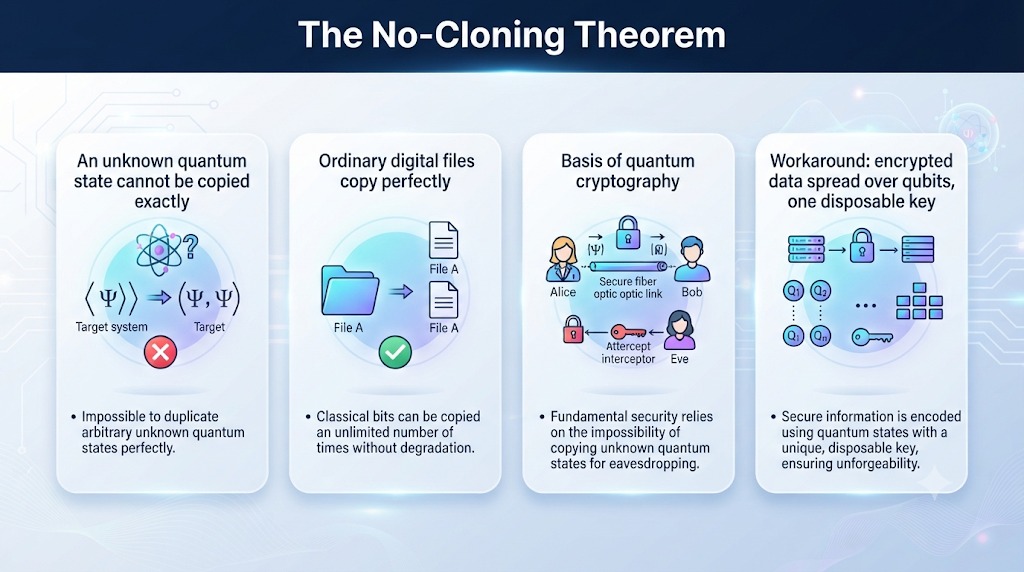
Consider the following statements regarding the no-cloning theorem in quantum mechanics: It prevents the creation of an identical duplicate of an arbitrary, unknown quantum state. It applies universally to all quantum states, regardless of whether they are pre-determined or completely unknown. Which of the statements given above is/are correct?
- 1 only
- 2 only
- Both 1 and 2
- Neither 1 nor 2
Practice questions are answered inside your account. Create a free account, or see what practice includes.
Which of the following best describes the primary reason why quantum mechanics bars a universal replication mechanism according to the linearity axiom?
- The massive computational power required to process quantum bits.
- The fact that any attempt to measure and copy an unknown state inevitably disturbs it.
- The total absence of decryption keys in contemporary quantum systems.
- The rapid decay of classical computers when exposed to entangled particles.
Practice questions are answered inside your account. Create a free account, or see what practice includes.
In the context of quantum cryptography and information security, what is the primary significance of the no-cloning theorem?
- It allows instantaneous long-distance communication without data loss.
- It ensures that unauthorized interception of quantum data introduces noticeable and detectable evidence.
- It permits unlimited flawless reproductions of digital files across conventional networks.
- It eliminates the need for encryption keys in cloud backup solutions.
Practice questions are answered inside your account. Create a free account, or see what practice includes.
Consider the following statements regarding error mitigation in quantum systems: Direct replication of quantum data is successfully used for error correction in modern processors. Safeguarding quantum data largely depends on entanglement-driven error correction since direct duplication is unattainable. Which of the statements given above is/are correct?
- 1 only
- 2 only
- Both 1 and 2
- Neither 1 nor 2
Practice questions are answered inside your account. Create a free account, or see what practice includes.