Paathara (Khoni) Practice
30 Jan 2026
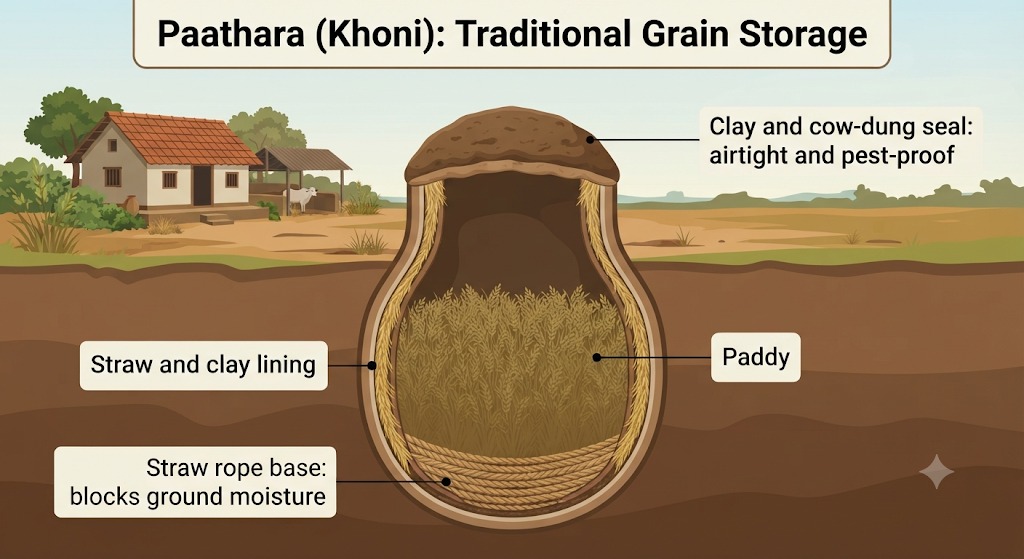
Consider the following statements regarding the Paathara (Khoni) storage tradition: It is an indigenous underground pit storage system primarily used for storing freshly harvested paddy. The tradition is widely practiced across the coastal zones of Andhra Pradesh to protect grains from high summer temperatures. Which of the statements given above is/are correct?
- 1 only
- 2 only
- Both 1 and 2
- Neither 1 nor 2
Practice questions are answered inside your account. Create a free account, or see what practice includes.
The Paathara (Khoni) traditional grain storage method is predominantly found in which of the following geographical regions?
- Godavari delta region of Andhra Pradesh
- Uddanam area in the Srikakulam district along the Mahendratanaya River basin
- Rayalseema uplands near the Penna River basin
- Coastal plains bordering the Pulicat Lake
Practice questions are answered inside your account. Create a free account, or see what practice includes.
In the construction of a traditional Paathara (Khoni) storage pit, which of the following materials is used to achieve a hermetically sealed and airtight environment?
- Portland cement and synthetic polymer sheets
- Galvanized iron sheets coated with tar
- A dense mixture of cow dung and clay
- Baked terracotta tiles sealed with tree resin
Practice questions are answered inside your account. Create a free account, or see what practice includes.
Why is the Paathara (Khoni) underground storage method largely absent in the coastal zones of Andhra Pradesh?
- Local customary laws strictly prohibit underground excavations near coastal sand dunes.
- Elevated soil moisture near the sea would cause the stored paddy to rot.
- The sandy soil texture in coastal areas makes it impossible to dig circular or rectangular pits.
- Marine humidity attracts invasive rodent species that neutralize the natural pest control.
Practice questions are answered inside your account. Create a free account, or see what practice includes.