The Himalayan Pangolin
7 Jul 2026
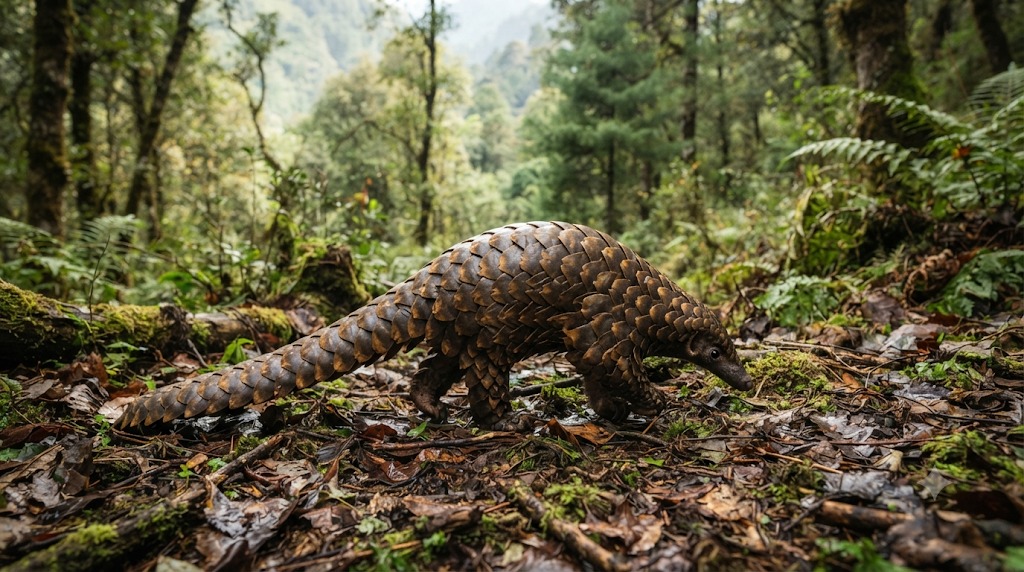
Consider the following statements regarding the Himalayan pangolin (Manis aurita): It has been formally re-established as a distinct living species rather than a subspecies of the Chinese pangolin. It is a diurnal mammal that relies primarily on sharp vision to hunt ants and termites. Which of the statements given above is/are correct?
- 1 only
- 2 only
- Both 1 and 2
- Neither 1 nor 2
Practice questions are answered inside your account. Create a free account, or see what practice includes.
Which of the following natural geographic boundaries played a significant role in maintaining the evolutionary separation of the Himalayan pangolin from other Asian pangolins?
- The Thar Desert and the Aravalli Range
- The Arakan Mountains and the Brahmaputra River drainage basin
- The Vindhya Range and the Narmada River valley
- The Western Ghats and the Krishna River basin
Practice questions are answered inside your account. Create a free account, or see what practice includes.
How does the anatomical structure of the Himalayan pangolin (Manis aurita) generally compare to that of the Chinese pangolin (Manis pentadactyla)?
- It possesses larger external ear pinnae and a longer, narrower nasal bone.
- It possesses smaller, highly reduced ear rims and a shorter, broader nasal bone.
- It lacks keratin scales entirely and possesses well-developed external ears.
- It features a slender nasal bone layout identical to lowland pangolins.
Practice questions are answered inside your account. Create a free account, or see what practice includes.
Consider the following features of the Himalayan pangolin: It is a specialized insectivore feeding primarily on ants and termites. Females typically produce a single pup after an extended gestation period. Infant pups are born with fully hardened protective scales. Which of the features given above are correct?
- 1 and 2 only
- 2 and 3 only
- 1 and 3 only
- 1, 2 and 3
Practice questions are answered inside your account. Create a free account, or see what practice includes.
In which of the following geographical regions have verified populations of the Himalayan pangolin (Manis aurita) been documented?
- The southern foothills of the Himalayas, including Nepal, South Tibet, and Northeast India
- The tropical rainforests of the Western Ghats and Sri Lanka
- The arid scrublands of northwestern India and the Deccan Plateau
- The mangrove ecosystems of the Sundarbans and coastal Myanmar
Practice questions are answered inside your account. Create a free account, or see what practice includes.