AI in Disaster Management
29 Sept 2026
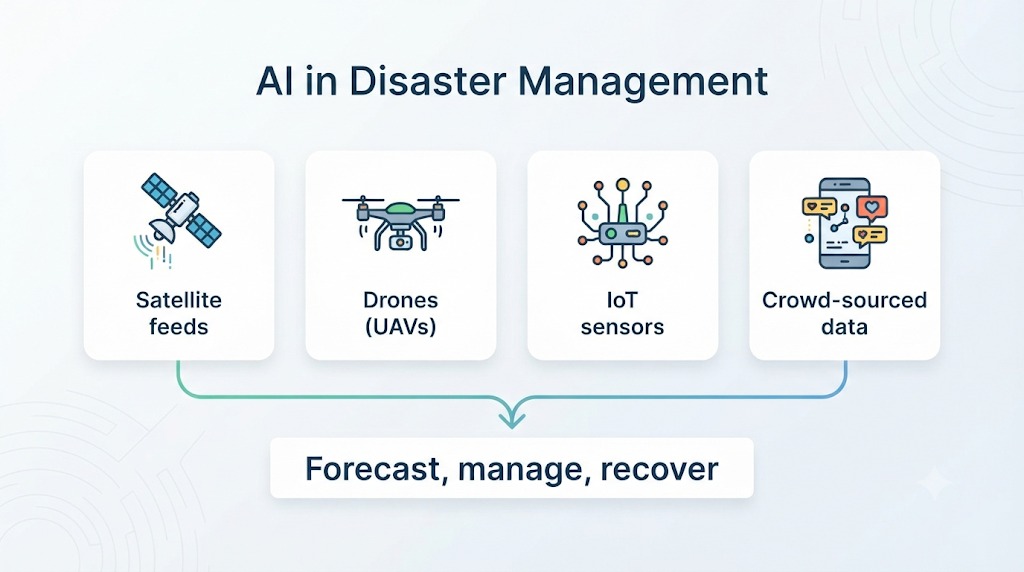
Consider the following statements regarding the application of Artificial Intelligence in disaster management: IIT Bombay's Centre for Climate Studies utilizes machine-learning architectures for hyperlocal meteorological nowcasting. Google’s Flood Hub produces inundation advisories up to seven days ahead by merging meteorological designs and hydrological records. GraphCast and DisasterAWARE are platforms used for integrated hazard mapping and dynamic threat evaluations. Which of the statements given above are correct?
- 1 and 2 only
- 2 and 3 only
- 1 and 3 only
- 1, 2 and 3
Practice questions are answered inside your account. Create a free account, or see what practice includes.
With reference to remote-sensing and data democratization in disaster response, consider the following applications: Thermal-imaging hardware operating computer vision on drones can detect human warmth signatures trapped beneath mudflows. Natural Language Processing frameworks help filter operational signals by deciphering unstructured, multilingual emergency SOS pleas. Automated damage audits rely exclusively on ground sensors without involving satellite imagery. Which of the statements given above is/are correct?
- 1 only
- 1 and 2 only
- 2 and 3 only
- 1, 2 and 3
Practice questions are answered inside your account. Create a free account, or see what practice includes.
Which of the following best describes the 'Ground-Truthing Bottleneck' limitation in the context of deploying AI for disaster management?
- The tendency of generative systems to produce inaccurate harm assessments and misguide rescue resources.
- The failure of algorithms to account for marginalized rural groups with minimal internet connectivity.
- The inability of predictive algorithms to preserve human life absent functional last-mile infrastructure and boots-on-the-ground rescue squads.
- The complete breakdown of cloud-based computational setups due to severed fiber-optic lines during cyclones.
Practice questions are answered inside your account. Create a free account, or see what practice includes.
Consider the following measures proposed under the 'Way Ahead' for resilient disaster governance: Deploying Edge-AI directly onto drone hardware and local handheld instruments to function during telecom network collapses. Merging AI risk models exclusively with concrete-heavy structural barriers, discarding traditional ecological knowledge. Enforcing Human-in-the-Loop safeguards to ensure automated recommendations are authenticated by seasoned officials. Which of the statements given above are correct?
- 1 and 2 only
- 2 and 3 only
- 1 and 3 only
- 1, 2 and 3
Practice questions are answered inside your account. Create a free account, or see what practice includes.