The Foreign Currency Non-Resident (Bank) — FCNR(B) Deposits
18 Aug 2026
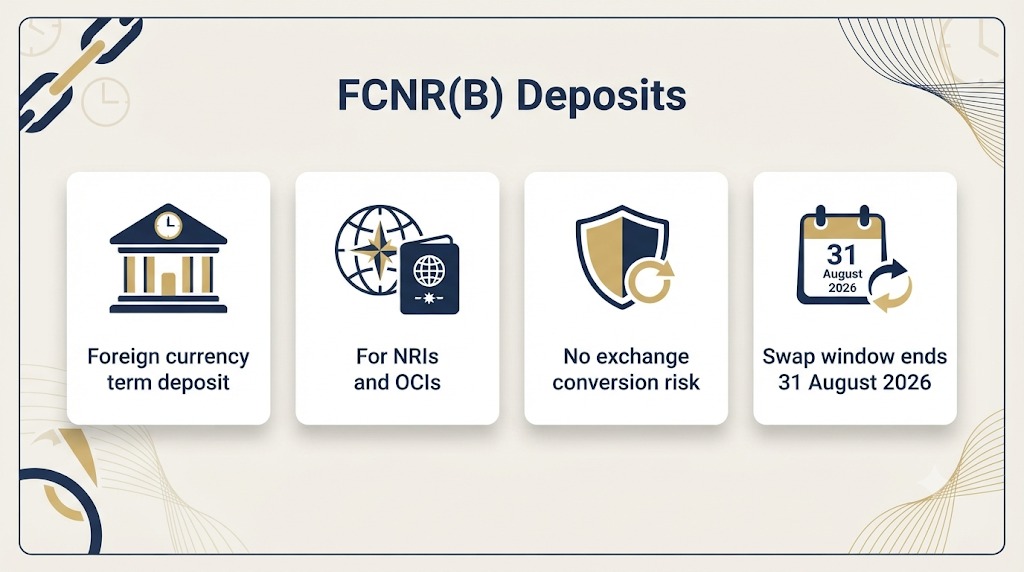
Consider the following statements regarding Foreign Currency Non-Resident (Bank) — FCNR(B) deposits in India: These deposits can be held in the form of savings, current, or term deposit accounts by eligible non-residents. Both the principal and interest amounts remain denominated in specified foreign currencies throughout the deposit tenor. The interest income earned on FCNR(B) deposits is fully exempt from Indian Income Tax for holders maintaining non-resident status. Which of the statements given above is/are correct?
- 1 and 2 only
- 2 and 3 only
- 1 and 3 only
- 1, 2, and 3
Practice questions are answered inside your account. Create a free account, or see what practice includes.
With reference to the Foreign Currency Non-Resident (Bank) [FCNR(B)] deposits scheme, consider the following statements: The initial FCNR program was introduced in 1975 with exchange risk borne by the government or the RBI. The modern FCNR(B) program, initiated in May 1993, shifted the management of foreign currency liabilities and exchange exposure directly to commercial banks. Which of the statements given above is/are correct?
- 1 only
- 2 only
- Both 1 and 2
- Neither 1 nor 2
Practice questions are answered inside your account. Create a free account, or see what practice includes.
Under the regulatory framework governing Foreign Currency Non-Resident (Bank) — FCNR(B) deposits, which of the following statutory guidelines directly supervise these accounts alongside RBI Master Directions?
- Banking Regulation Act, 1949
- Foreign Exchange Management Act (FEMA), 1999
- Securities and Exchange Board of India Act, 1992
- Prevention of Money Laundering Act, 2002
Practice questions are answered inside your account. Create a free account, or see what practice includes.
Which of the following best describes the primary operational objective of the RBI special forex swap window concerning FCNR(B) deposits during targeted mobilization periods?
- To provide commercial banks with long-term rupee loans for agricultural debt waiver schemes
- To enable commercial banks to transfer foreign currency principal to the RBI in exchange for rupees while removing hedging expenses through a forward repurchase contract
- To force commercial banks to convert all foreign currency deposits compulsorily into Indian Rupees at the time of deposit
- To impose higher CRR and SLR requirements on commercial banks to curb excess liquidity
Practice questions are answered inside your account. Create a free account, or see what practice includes.
What is the permissible maturity period (tenor) range for Foreign Currency Non-Resident (Bank) — FCNR(B) deposits?
- 7 days to 1 year
- 1 month to 3 years
- 1 year to 5 years
- 3 years to 10 years
Practice questions are answered inside your account. Create a free account, or see what practice includes.