Kyasanur Forest Disease (KFD)
9 Feb 2026
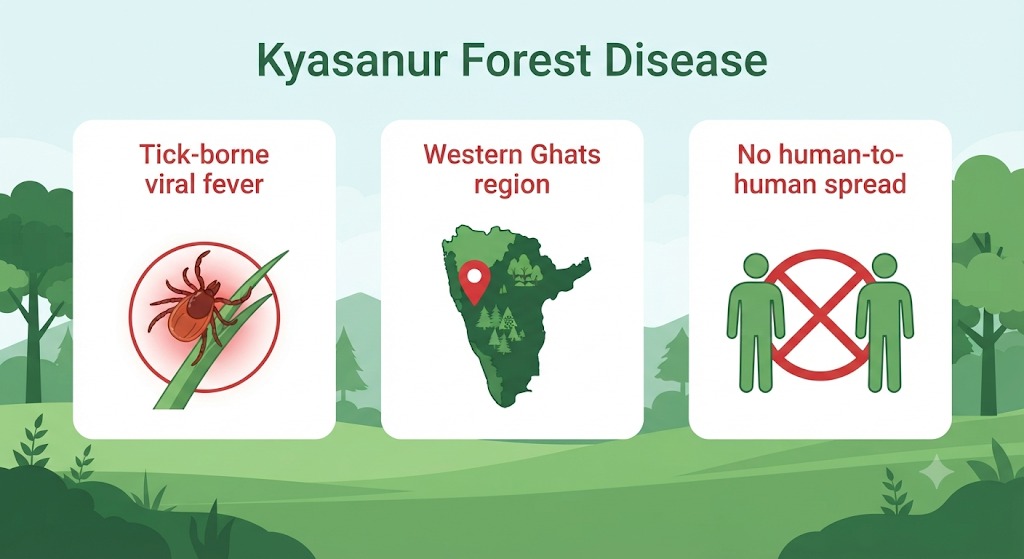
Consider the following statements regarding Kyasanur Forest Disease (KFD): It is a viral haemorrhagic fever transmitted primarily by the bite of hard ticks. Human-to-human transmission is a major route of spreading the infection during outbreaks. Which of the statements given above is/are correct?
- 1 only
- 2 only
- Both 1 and 2
- Neither 1 nor 2
Practice questions are answered inside your account. Create a free account, or see what practice includes.
Which of the following best describes the vector and transmission mode of Kyasanur Forest Disease?
- Aedes mosquitoes and direct blood transfusion
- Hard ticks (Hemaphysalis spinigera) and handling infected animals like monkeys
- Contaminated water and food consumption
- Airborne droplets through coughing and sneezing
Practice questions are answered inside your account. Create a free account, or see what practice includes.
Consider the symptoms and clinical progression of Kyasanur Forest Disease: The incubation period typically ranges from 3 to 8 days. A significant percentage of patients experience a second phase involving neurological symptoms such as tremors. Which of the statements given above is/are correct?
- 1 only
- 2 only
- Both 1 and 2
- Neither 1 nor 2
Practice questions are answered inside your account. Create a free account, or see what practice includes.
In which of the following regions of India is Kyasanur Forest Disease primarily endemic?
- Eastern Himalayas
- Western Ghats
- Thar Desert
- Gangetic Plains
Practice questions are answered inside your account. Create a free account, or see what practice includes.