OLED (Organic Light Emitting Diodes)↗
6 May 2026
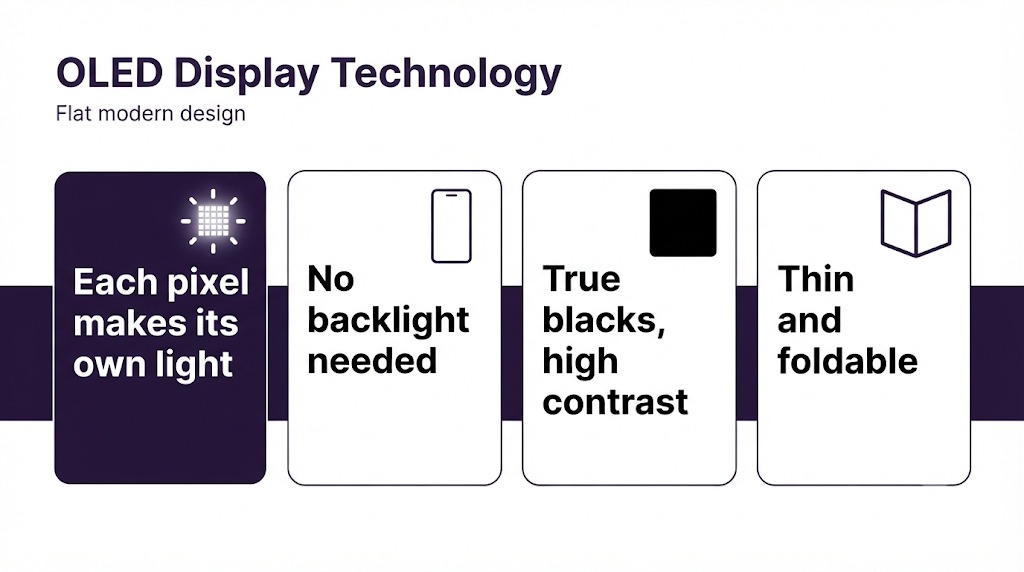
Consider the following statements regarding Organic Light Emitting Diode (OLED) technology: Unlike traditional liquid crystal displays, OLED panels rely on a separate external backlight to illuminate individual pixels. The organic compounds used in these displays are primarily composed of carbon and hydrogen. Which of the statements given above is/are correct?
- 1 only
- 2 only
- Both 1 and 2
- Neither 1 nor 2
Practice questions are answered inside your account. Create a free account, or see what practice includes.
Which of the following best describes the fundamental mechanism responsible for light emission in an OLED display?
- Filtration of white light through liquid crystal matrices
- Excitation of carbon-based organic molecules by an electrical current and their subsequent return to the ground state
- Plasma discharge within inert gas-filled pixel chambers
- Secondary emission of electrons induced by a high-voltage vacuum tube
Practice questions are answered inside your account. Create a free account, or see what practice includes.
Consider the following characteristics of OLED technology: Ability to achieve true blacks and infinite contrast ratios Inherent structural flexibility allowing rollable and foldable form factors High consumption of constant power regardless of pixel color output Which of the characteristics given above are correct?
- 1 and 2 only
- 2 and 3 only
- 1 and 3 only
- 1, 2 and 3
Practice questions are answered inside your account. Create a free account, or see what practice includes.
In the context of modern electronics and emerging applications, transparent OLEDs are notably integrated into which of the following?
- Traditional heavy cathode-ray tube monitors
- Car windshields and efficient automotive lighting
- Standard non-backlit mechanical wristwatch dials
- High-pressure deep sea exploration submersibles
Practice questions are answered inside your account. Create a free account, or see what practice includes.