The Proposed Reset: National Food Security (Amendment) Bill, 2026
13 Aug 2026
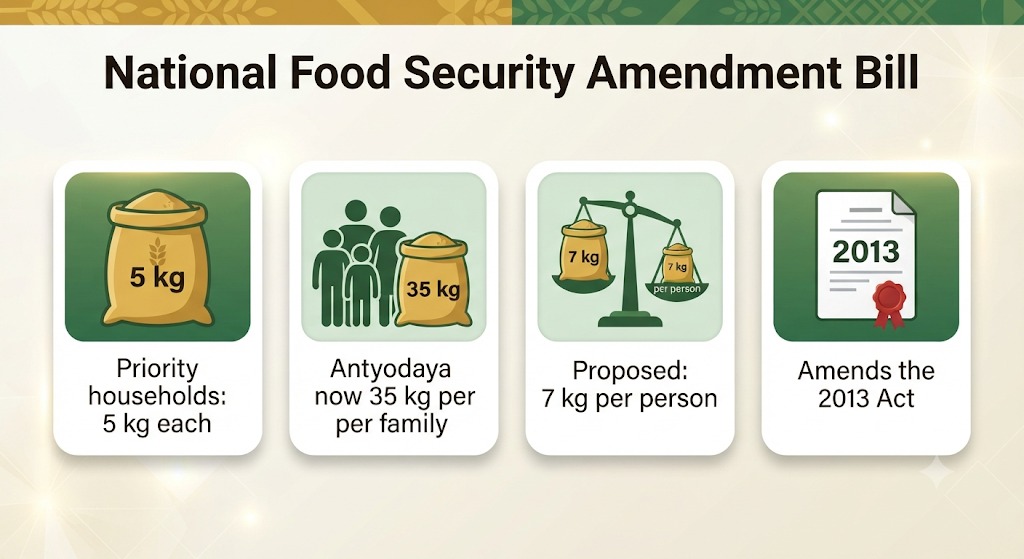
Consider the following statements regarding the proposed National Food Security (Amendment) Bill, 2026: It amends the first proviso in Section 3(1) of the National Food Security Act (NFSA), 2013. It completely abolishes the 35 kg per-family monthly ceiling for Antyodaya Anna Yojana (AAY) households. Every individual in an AAY family will qualify for a fixed 7 kg of foodgrains monthly, subject to an aggregate family ceiling. Which of the statements given above are correct?
- 1 and 3 only
- 1 and 2 only
- 2 and 3 only
- 1, 2 and 3
Practice questions are answered inside your account. Create a free account, or see what practice includes.
With reference to the demographic coverage and population ceilings under the National Food Security Act (NFSA), which of the following statements is accurate?
- The beneficiary cap for NFSA is currently updated annually based on mid-year population projections by the Ministry of Health.
- The NFSA beneficiary cap remains fixed based on the 2011 Census, covering 81.35 crore individuals, which translates to roughly 55.6 percent of the projected 2025 population.
- The statutory coverage goals under the NFSA mandate 60% urban and 70% rural coverage.
- The 2026 amendment immediately expands the beneficiary cap to match the projected 2025 population of 146.4 crore.
Practice questions are answered inside your account. Create a free account, or see what practice includes.
Consider the following findings regarding nutritional status and dietary patterns in India, as highlighted in public health analyses: The proportion of Indian families unable to afford the healthy diet recommended by ICMR-NIN has increased between 2011-12 and 2023-24. Carbohydrates provide over 60 percent of everyday national energy intake, whereas protein contributes a significantly smaller fraction. Child stunting rates under 5 years have decreased, while child wasting and underweight percentages have remained mostly unchanged. Which of the statements given above are correct?
- 1 and 2 only
- 2 and 3 only
- 1 and 3 only
- 1, 2 and 3
Practice questions are answered inside your account. Create a free account, or see what practice includes.
What is the primary rationale behind shifting the Antyodaya Anna Yojana (AAY) foodgrain distribution from a fixed household quota to a per-person allocation under the proposed 2026 amendment?
- To completely phase out the Public Distribution System (PDS) in favour of Direct Benefit Transfers (DBT)
- To eliminate structural imbalances and intra-category inequities where smaller AAY families receive higher per capita foodgrain amounts than larger ones
- To reduce the total financial burden of food subsidies by drastically cutting grain allocations for all states regardless of household size
- To replace cereal distribution entirely with pulse and edible oil allocations
Practice questions are answered inside your account. Create a free account, or see what practice includes.