Hanamkonda’s Thousand Pillar Temple↗
9 May 2026
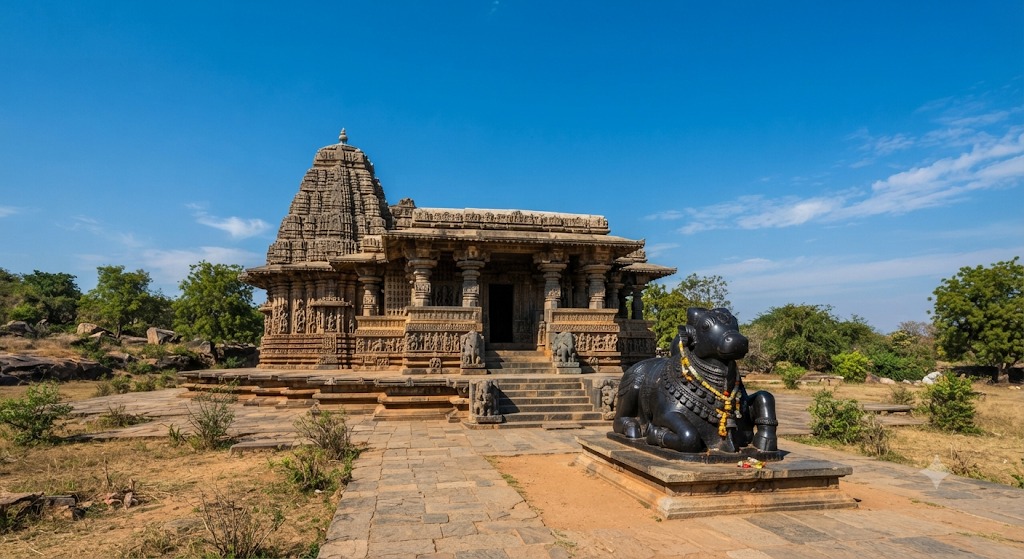
Consider the following statements regarding the Thousand Pillar Temple at Hanamkonda: It was built by the Kakatiya monarch Rudra Deva in the 12th century. It is designed as a Trikutalaya consecrated to Lord Shiva, Vishnu, and Brahma. The monolithic Nandi of the temple is carved from a single piece of black basalt stone. Which of the statements given above are correct?
- 1 and 2 only
- 1 and 3 only
- 2 and 3 only
- 1, 2 and 3
Practice questions are answered inside your account. Create a free account, or see what practice includes.
With reference to the Kakatiya-era sandbox technology used in historical structures like the Thousand Pillar Temple, consider the following statements: It relies on a deep excavation filled with a mixture of sand, lime, jaggery, and karakkaya. The sandbox foundation acts as a shock absorber that can significantly reduce seismic and vibrational impact forces. It is ideally suited for modern multi-story skyscrapers and ultra-tall contemporary buildings. Which of the statements given above are correct?
- 1 and 2 only
- 2 and 3 only
- 1 and 3 only
- 1, 2 and 3
Practice questions are answered inside your account. Create a free account, or see what practice includes.
The historic Kalyana Mandapam restoration that concluded recently after 42 years belongs to which of the following monuments?
- Ramappa Temple at Palampet
- Thousand Pillar Temple at Hanamkonda
- Suryanarayana Temple at Arasavalli
- Padmakshi Temple at Warangal
Practice questions are answered inside your account. Create a free account, or see what practice includes.
During whose invasion in the 14th century (1323-24) did the dance hall of the Thousand Pillar Temple suffer severe destruction?
- Malik Kafur
- Ulugh Khan
- Ahmad Shah Bahmani
- Qutb Shah
Practice questions are answered inside your account. Create a free account, or see what practice includes.
In the traditional geotechnical sandbox technology developed by the Kakatiyas, what purpose do ingredients like jaggery and karakkaya serve?
- They act as chemical coloring agents to dye the stone pillars.
- They act as binding agents in the sand-and-lime trench mixture.
- They serve as organic pest repellents to protect wooden roof beams.
- They accelerate the weathering of sand to speed up structural settling.
Practice questions are answered inside your account. Create a free account, or see what practice includes.