The Dadasaheb Phalke Award
17 Sept 2026
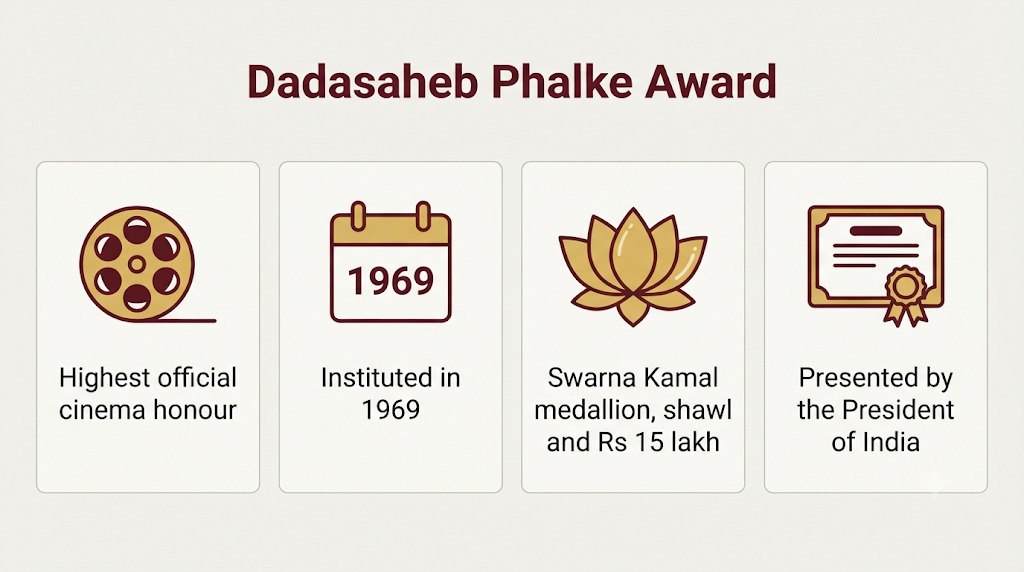
Consider the following statements regarding the Dadasaheb Phalke Award: It is India's highest official recognition in the field of cinema. The award was instituted in 1969 to commemorate the birth centenary of Dhundiraj Govind Phalke. It is presented annually by the Prime Minister of India. Which of the statements given above are correct?
- 1 and 2 only
- 2 and 3 only
- 1 and 3 only
- 1, 2 and 3
Practice questions are answered inside your account. Create a free account, or see what practice includes.
With reference to the Dadasaheb Phalke Award, who among the following was its inaugural recipient?
- Prithviraj Kapoor
- Devika Rani
- Anant Nag
- Dhundiraj Govind Phalke
Practice questions are answered inside your account. Create a free account, or see what practice includes.
What does the winner of the Dadasaheb Phalke Award receive as part of the prize elements?
- A cash purse of ₹10 lakh and a Silver Lotus medallion
- A cash purse of ₹15 lakh and a Swarna Kamal medallion
- A citation and a cash purse of ₹20 lakh without any medallion
- A Swarna Kamal medallion and a trophy made of pure silver
Practice questions are answered inside your account. Create a free account, or see what practice includes.
Consider the following statements regarding the posthumous conferment of the Dadasaheb Phalke Award: The award has never been given posthumously under any circumstance. Prithviraj Kapoor and Vinod Khanna are among the few who have received this honor posthumously. Which of the statements given above is/are correct?
- 1 only
- 2 only
- Both 1 and 2
- Neither 1 nor 2
Practice questions are answered inside your account. Create a free account, or see what practice includes.
Dhundiraj Govind Phalke, in whose honor the prestigious cinema award is named, is best known in Indian film history for directing which of the following?
- Alam Ara (1931)
- Raja Harishchandra (1913)
- Pundalik (1912)
- Kisan Kanya (1937)
Practice questions are answered inside your account. Create a free account, or see what practice includes.