Prosopis juliflora↗
4 May 2026
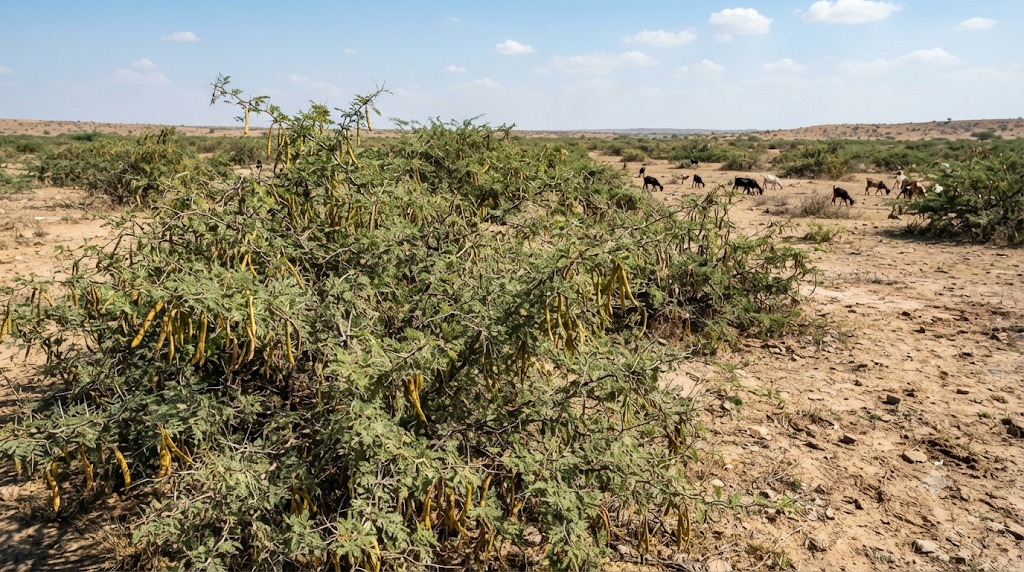
Consider the following statements regarding Prosopis juliflora: It belongs to the Fabaceae family and is native to Mexico, South America, and the Caribbean. It was introduced to India during the late 19th century to combat desertification and provide fuelwood. It exhibits allelopathy, secreting chemicals that suppress the growth of nearby native plants. Which of the statements given above are correct?
- 1 and 2 only
- 2 and 3 only
- 1 and 3 only
- 1, 2 and 3
Practice questions are answered inside your account. Create a free account, or see what practice includes.
A pilot initiative was recently undertaken by the Kandla (Deendayal) Port in Gujarat to convert Prosopis juliflora into which of the following?
- Bio-methanol for clean maritime fuel
- Bio-ethanol for blended automotive fuel
- Biodiesel for railway locomotive engines
- Compressed biogas for domestic cooking
Practice questions are answered inside your account. Create a free account, or see what practice includes.
With reference to the introduction of Prosopis juliflora into India, consider the following: It was brought into India by the British in the year 1877. The initial introduction targeted the dry territories of Rajasthan and Gujarat. Which of the statements given above is/are correct?
- 1 only
- 2 only
- Both 1 and 2
- Neither 1 nor 2
Practice questions are answered inside your account. Create a free account, or see what practice includes.
Which of the following negative ecological impacts is directly associated with the spread of Prosopis juliflora in regions like the Banni grasslands of Gujarat?
- Enrichment of native soil biodiversity and increased groundwater tables
- Displacement of indigenous flora, reduction of livestock fodder, and severe water depletion
- Promotion of diverse multi-layered forest canopies supporting endemic wildlife
- Enhancement of productive pasture lands through nitrogen fixation
Practice questions are answered inside your account. Create a free account, or see what practice includes.