Thermal Energy Storage (TES) Systems↗
23 May 2026
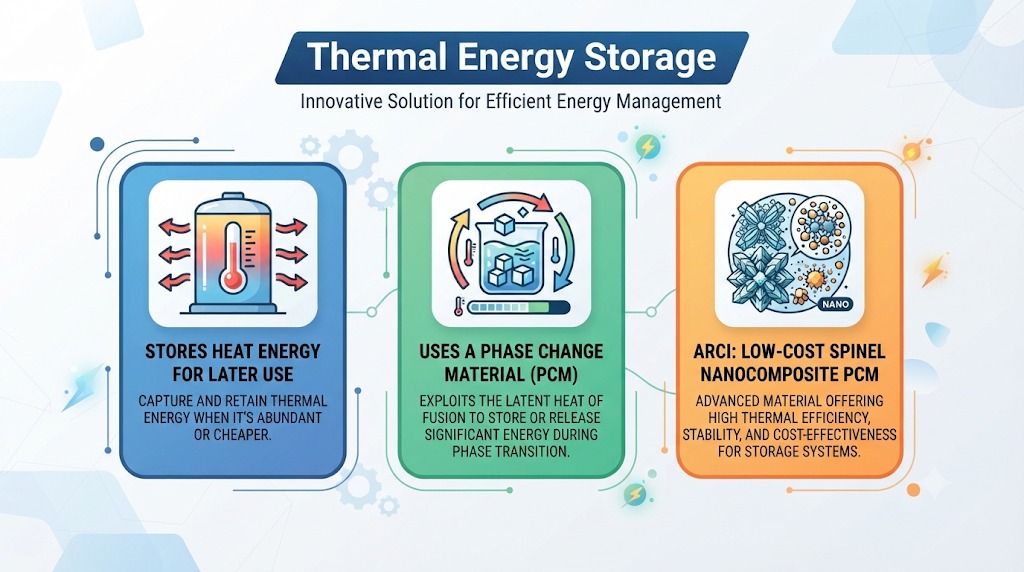
Consider the following statements regarding Thermal Energy Storage (TES) systems and the recent ARCI innovation: Sensible heat storage in conventional TES structures relies on Phase Change Materials (PCMs) that take in energy during phase shifts. The newly developed spinel nanocomposite PCM incorporates a 1% nanoparticle inclusion rate which achieves a 45% improvement in specific heat capacity. The co-precipitated spinel metal oxides decrease thermal cycling durability over thousands of melting cycles. Which of the statements given above is/are correct?
- 1 only
- 2 only
- 2 and 3 only
- 1, 2 and 3
Practice questions are answered inside your account. Create a free account, or see what practice includes.
With reference to the operational mechanics of the recently unveiled spinel nanocomposite Phase Change Material (PCM), what role do the spinel nanoparticles play?
- They act as the base medium that directly undergoes liquefaction during the charging phase.
- They form a resilient oxide film at internal boundaries that enlarges surface area and structural surface energy.
- They circulate as thermal transfer fluid through the liquid PCM to cool the system down rapidly.
- They prevent the charging phase from reaching the liquefaction point to avoid energy loss.
Practice questions are answered inside your account. Create a free account, or see what practice includes.
Which institution developed the low-cost, high-performance spinel nanocomposite Phase Change Material (PCM) designed for thermal energy storage?
- Indian Institute of Science (IISc)
- International Advanced Research Centre for Powder Metallurgy and New Materials (ARCI)
- Defence Research and Development Organisation (DRDO)
- National Physical Laboratory (NPL)
Practice questions are answered inside your account. Create a free account, or see what practice includes.