The High-Energy Medical Cyclotron Project (HEMCP)
17 Jun 2026
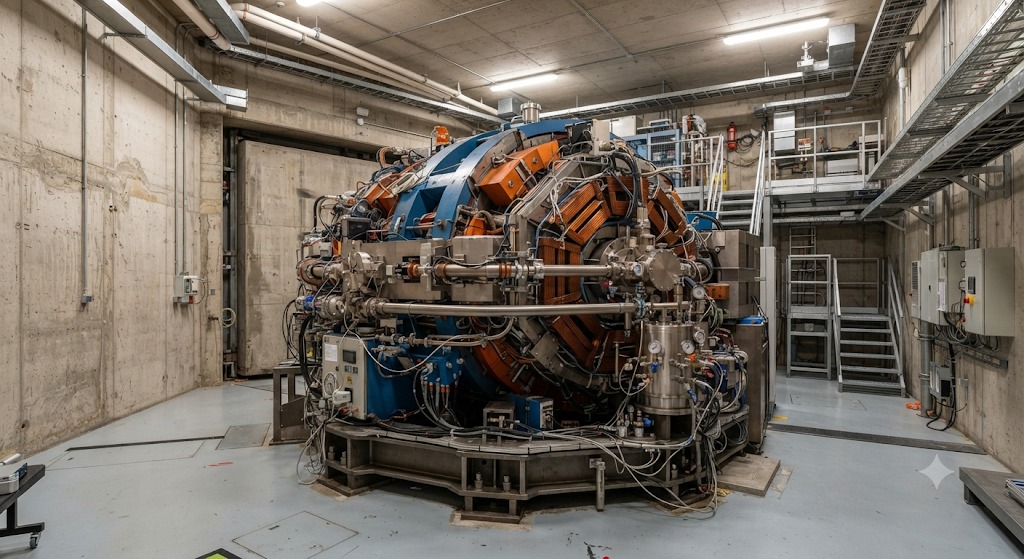
Consider the following statements regarding the High-Energy Medical Cyclotron Project (HEMCP): It is established with an outlay of ₹300 crore in Nagpur. The facility is funded entirely by the Central Government's Department of Atomic Energy. Which of the statements given above is/are correct?
- 1 only
- 2 only
- Both 1 and 2
- Neither 1 nor 2
Practice questions are answered inside your account. Create a free account, or see what practice includes.
In the operational mechanism of a medical cyclotron, what is the primary role of alternating radio-frequency electric fields and strong magnetic forces?
- To cool down the target materials to absolute zero
- To drive charged subatomic particles in a rapidly widening spiral trajectory
- To shield hospital staff from secondary gamma radiation
- To automatically synthesize radiopharmaceuticals without chemical bonding
Practice questions are answered inside your account. Create a free account, or see what practice includes.
Consider the following applications: Advanced PET-CT Diagnostic Imaging Targeted Nuclear Medicine Therapies Oncological Research and Drug Discovery Which of the above are primary medical uses supported by the production of short-lived radioisotopes at the HEMCP facility?
- 1 and 2 only
- 2 and 3 only
- 1 and 3 only
- 1, 2, and 3
Practice questions are answered inside your account. Create a free account, or see what practice includes.
What is the designated institutional governance and operational mechanism planned for the Nagpur HEMCP facility?
- Managed directly by the Union Ministry of Health and Family Welfare
- Operated under a dedicated Special Purpose Vehicle (SPV) managed through Mahacare
- Run as a private sector joint venture by pharmaceutical multinationals
- Supervised entirely by the Indian Council of Medical Research (ICMR)
Practice questions are answered inside your account. Create a free account, or see what practice includes.
Which of the following radioactive isotopes mentioned in the project context are produced to support advanced oncological applications?
- Uranium-235, Plutonium-239, and Thorium-232
- Iodine-123, Carbon-11, and Fluorine-18
- Cobalt-60, Cesium-137, and Radium-226
- Sodium-24, Potassium-42, and Phosphorus-32
Practice questions are answered inside your account. Create a free account, or see what practice includes.