The Debate Over the 10th Schedule↗
27 Apr 2026
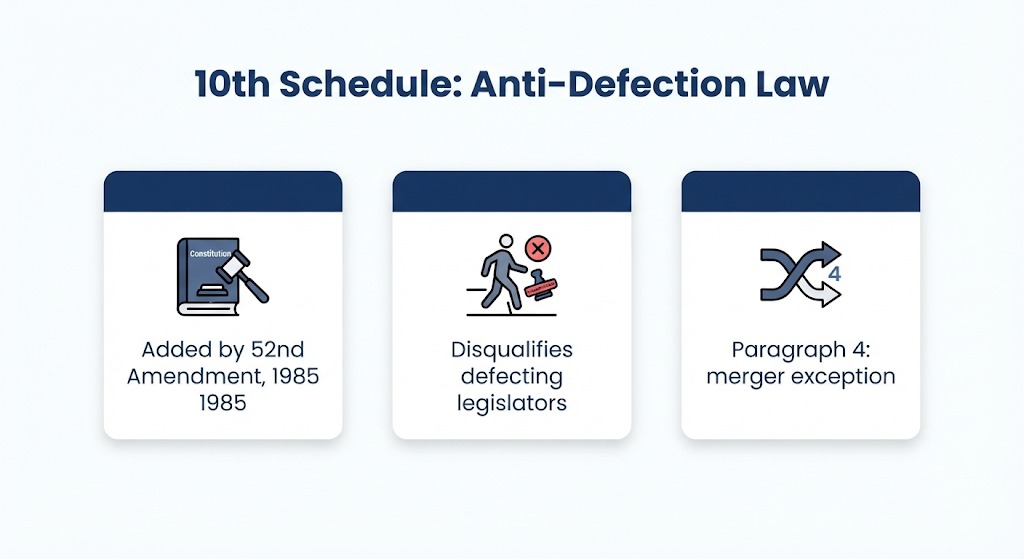
Consider the following statements regarding the Tenth Schedule of the Constitution of India: It was added to the Constitution by the 52nd Constitutional Amendment Act of 1985. The 91st Constitutional Amendment Act of 2003 removed the exemption that previously allowed a one-third split in a legislative party to escape disqualification. The Supreme Court in the Kihoto Hollohan judgment ruled that decisions of the presiding officer regarding disqualification are completely immune from judicial review. Which of the statements given above is/are correct?
- 1 only
- 1 and 2 only
- 2 and 3 only
- 1, 2 and 3
Practice questions are answered inside your account. Create a free account, or see what practice includes.
What is the minimum fraction of legislators required under the current provisions of the Tenth Schedule to validate a merger with another political party without attracting disqualification?
- One-third
- One-half
- Two-thirds
- Three-fourths
Practice questions are answered inside your account. Create a free account, or see what practice includes.
Consider the following reform suggestions concerning the anti-defection laws in India: Transferring the disqualification adjudication powers from the Speaker to a permanent independent tribunal or the Election Commission. Restricting the application of the party whip exclusively to crucial floor tests such as No-Confidence Motions. Codifying a mandatory timeframe, such as three months, for presiding officers to decide on disqualification petitions. Which of these recommendations have been proposed to address the shortcomings of the Tenth Schedule?
- 1 and 2 only
- 2 and 3 only
- 1 and 3 only
- 1, 2 and 3
Practice questions are answered inside your account. Create a free account, or see what practice includes.
In the context of the Tenth Schedule, the Supreme Court ruling in the Subhash Desai case primarily clarified which of the following constitutional aspects?
- That the Speaker must decide all disqualification petitions within a strict 30-day window.
- That the legislative faction of a party cannot function independently or supersede the broader parent political apparatus.
- That independent members are legally permitted to merge with national political parties.
- That judicial review cannot apply until the presiding officer issues a final administrative order.
Practice questions are answered inside your account. Create a free account, or see what practice includes.