Fiscal federalism, efficiency versus equity concerns
6 Aug 2026
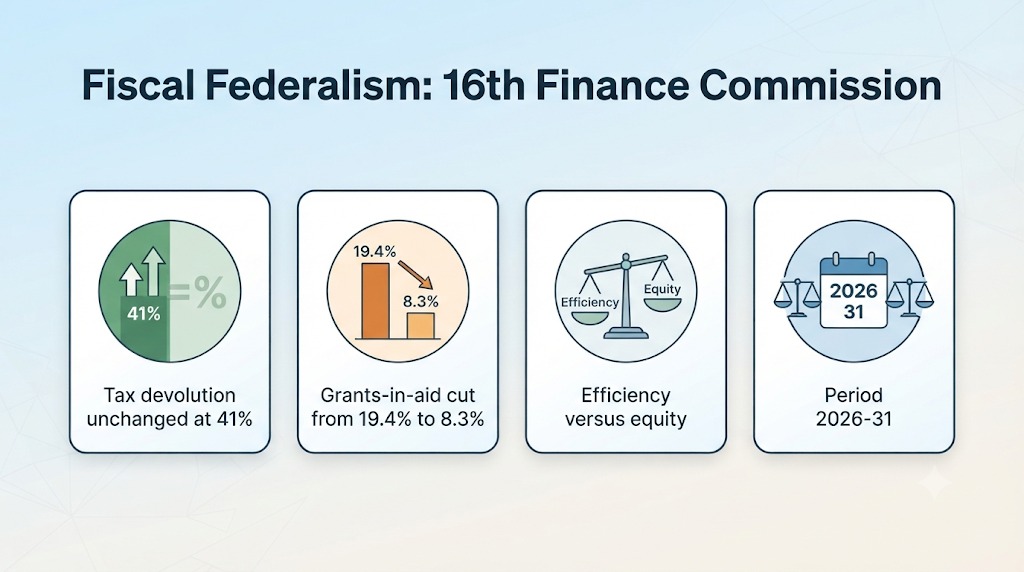
Consider the following recommendations regarding the 16th Finance Commission's fiscal architecture for the period 2026–31: It maintained vertical tax devolution to states at 41% of the divisible pool. It completely abolished Revenue Deficit Grants and state-specific grants. It raised the weight given to the income distance criterion in horizontal tax devolution from 45% to 50%. Which of the statements given above is/are correct?
- 1 only
- 1 and 2 only
- 2 and 3 only
- 1, 2 and 3
Practice questions are answered inside your account. Create a free account, or see what practice includes.
Which of the following constitutional provisions is primarily cited as the foundational tool for targeted fiscal equalization through Grants-in-Aid to handle specific, non-formulaic state needs?
- Article 263
- Article 275
- Article 282
- Article 301
Practice questions are answered inside your account. Create a free account, or see what practice includes.
With reference to the horizontal tax devolution matrix adopted by the 16th Finance Commission, a new inclusion was introduced by assigning a specific weightage to which of the following metrics?
- State GDP contribution
- Total geographical land area
- Decadal population growth rate
- Per capita renewable energy generation
Practice questions are answered inside your account. Create a free account, or see what practice includes.
What was the primary rationale behind the widespread criticism that the 16th Finance Commission's recommendations create a 'double disadvantage' for certain vulnerable states?
- Complete elimination of all local body grants across all tiers
- Simultaneous lowering of the income distance weight and cutting of Revenue Deficit Grants
- Mandatory diversion of state tax revenues to central cesses and surcharges
- Imposition of strict penalties on states with high forest cover
Practice questions are answered inside your account. Create a free account, or see what practice includes.
Consider the following statements regarding the structural challenges of fiscal federalism in India: The Constitution vests primary taxation authority in the Union while assigning heavy social sector spending obligations to the States. Non-shareable cesses and surcharges levied by the Centre remain outside the divisible tax pool, affecting state revenue shares. Which of the statements given above is/are correct?
- 1 only
- 2 only
- Both 1 and 2
- Neither 1 nor 2
Practice questions are answered inside your account. Create a free account, or see what practice includes.