The Linear No-Threshold (LNT) Model
23 Feb 2026
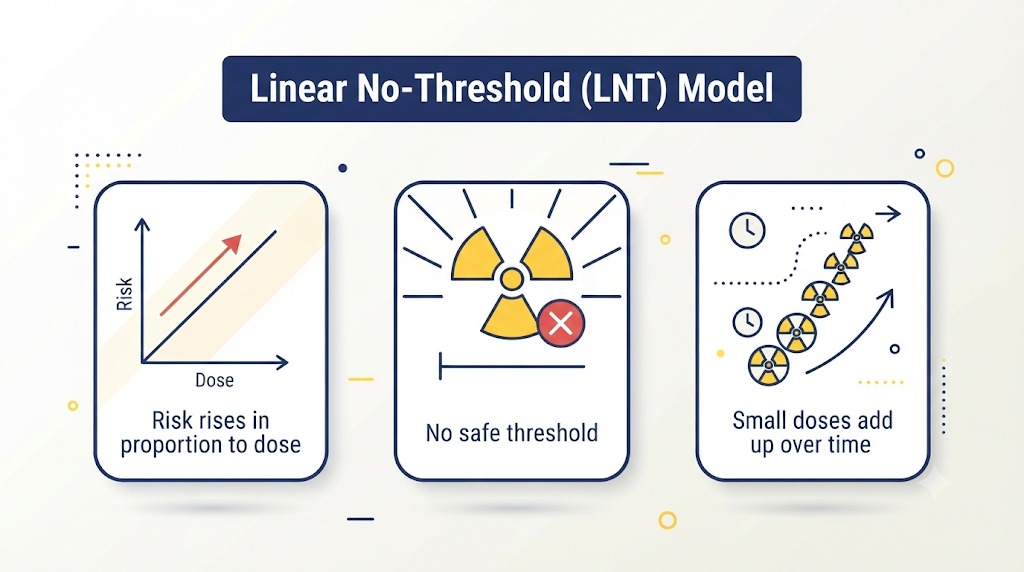
Which of the following best describes the core assumption of the Linear No-Threshold (LNT) model regarding ionizing radiation?
- There is a safe lower threshold below which radiation exposure causes no biological damage.
- Biological damage occurs only when radiation doses exceed cumulative natural background levels.
- Even the smallest dose of radiation carries a proportional statistical risk of causing cancer or biological damage.
- The body completely repairs all low-dose radiation damage, making cumulative effects negligible.
Practice questions are answered inside your account. Create a free account, or see what practice includes.
Consider the following statements regarding the ALARA principle: It stands for 'As Low As Reasonably Achievable'. It serves as the operational framework derived from the Linear No-Threshold model. It requires keeping radiation exposure absolute to zero, regardless of socio-economic costs. Which of the statements given above are correct?
- 1 and 2 only
- 2 and 3 only
- 1 and 3 only
- 1, 2 and 3
Practice questions are answered inside your account. Create a free account, or see what practice includes.
Recent policy changes by which country's Department of Energy removed the ALARA principle from its radiation safety directives, sparking global debate?
- United Kingdom
- United States
- France
- Japan
Practice questions are answered inside your account. Create a free account, or see what practice includes.
Which of the following are recognized as the core pillars of radiation protection under the operational guidance of the ALARA principle?
- Absorption, Elimination, and Decay
- Frequency, Intensity, and Duration
- Time, Distance, and Shielding
- Isolation, Containment, and Dilution
Practice questions are answered inside your account. Create a free account, or see what practice includes.
The historical origins of the Linear No-Threshold (LNT) model can be traced back to the research on radiation-induced mutations in fruit flies conducted by which scientist in the late 1920s?
- Hermann Muller
- Marie Curie
- Enrico Fermi
- Wilhelm Röntgen
Practice questions are answered inside your account. Create a free account, or see what practice includes.