Glacial Lake Outburst Floods (GLOFs)
31 Oct 2026
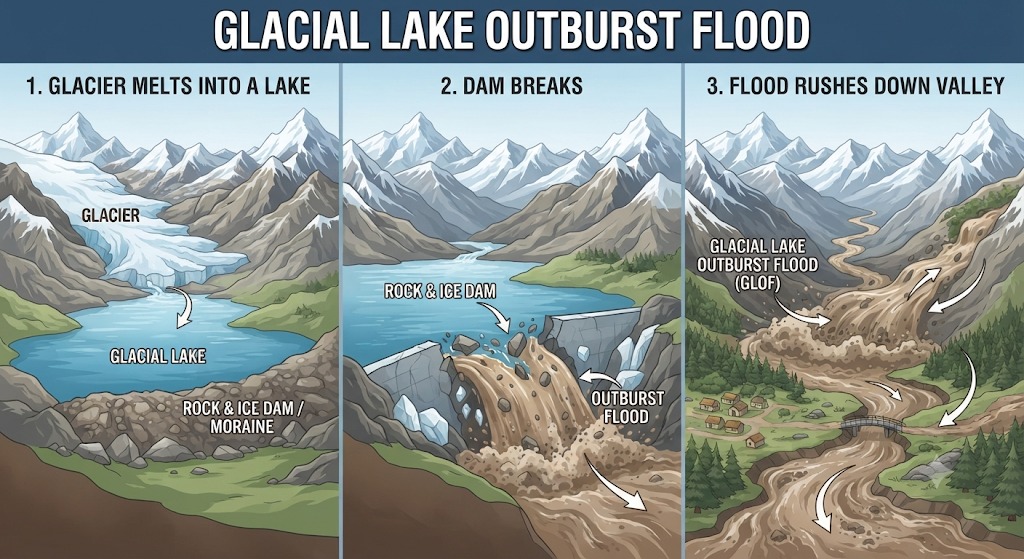
Consider the following statements regarding Glacial Lake Outburst Floods (GLOFs): A GLOF is caused by the sudden and destructive discharge of water held back by unstable natural barriers such as moraines. Over the past three decades, remote sensing studies show that the area of proglacial lakes in the Hindu Kush Himalayas has decreased significantly. Which of the statements given above is/are correct?
- 1 only
- 2 only
- Both 1 and 2
- Neither 1 nor 2
Practice questions are answered inside your account. Create a free account, or see what practice includes.
Which of the following river systems experienced sudden flash floods following the glacial lake outburst flood at Shintaphu Lake in Bhutan?
- Indus and Sutlej river systems
- Mo Chhu and Sankosh river systems
- Teesta and Brahmaputra river systems
- Ganga and Yamuna river systems
Practice questions are answered inside your account. Create a free account, or see what practice includes.
Consider the following triggers for a Glacial Lake Outburst Flood (GLOF): Avalanches of ice or rock into the lake causing displacement waves Thawing permafrost weakening the internal structure of moraine dams Decreased regional temperatures causing rapid refreezing of glacial barriers Which of the triggers given above are generally associated with GLOFs?
- 1 and 2 only
- 2 and 3 only
- 1 and 3 only
- 1, 2 and 3
Practice questions are answered inside your account. Create a free account, or see what practice includes.
According to the National Disaster Management Authority (NDMA) guidelines on managing GLOFs, which of the following is recommended for high-risk glacial lakes?
- Construction of heavy permanent tourism infrastructure around the lakes
- Controlled draining of water through siphoning, pumping, or controlled trenching
- Complete sealing of river outlets downstream to trap floodwaters
- Reforestation of high-altitude lake beds using exotic plant species
Practice questions are answered inside your account. Create a free account, or see what practice includes.
In the context of the geography and transboundary risks of the Himalayan region, approximately how long does floodwater take to arrive in the crowded plains of Assam and West Bengal from the glaciated areas of Bhutan and Tibet?
- 1 to 2 hours
- 6 to 8 hours
- 24 to 36 hours
- 3 to 5 days
Practice questions are answered inside your account. Create a free account, or see what practice includes.