Global Water Bankruptcy Report
23 Jan 2026
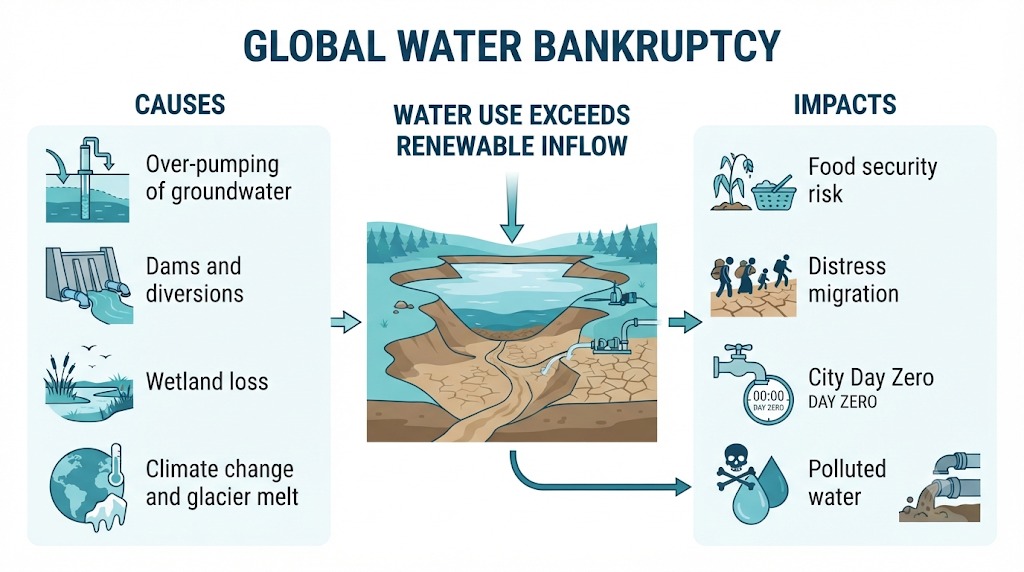
With reference to the 'Global Water Bankruptcy' framework published by the United Nations University Institute for Water, Environment and Health (UNU-INWEH), consider the following statements: It defines a continuous post-crisis state where long-term consumption permanently outpaces renewable replenishment and safe depletion limits. It asserts that traditional terms such as 'water stress' and 'water crisis' remain adequate for capturing long-term structural ecological changes. Which of the statements given above is/are correct?
- 1 only
- 2 only
- Both 1 and 2
- Neither 1 nor 2
Practice questions are answered inside your account. Create a free account, or see what practice includes.
According to the UNU-INWEH Global Water Bankruptcy report, what percentage of the global population resides in nations categorized as water-insecure or critically water-insecure as of 2026?
- About 50%
- About 65%
- About 75%
- About 90%
Practice questions are answered inside your account. Create a free account, or see what practice includes.
Consider the following root causes of water bankruptcy outlined in the UNU-INWEH report: Slow-onset depletion driven by chronic over-allocation and excessive extraction. Infrastructure-driven overshoot via large-scale dams and diversion projects encouraging growth beyond sustainable thresholds. Ecological liquidation through the conversion of wetlands and forests, eliminating natural buffers. Which of the above are identified as root causes?
- 1 and 2 only
- 2 and 3 only
- 1 and 3 only
- 1, 2, and 3
Practice questions are answered inside your account. Create a free account, or see what practice includes.
Which of the following best describes the primary recommendation of the Global Water Bankruptcy report regarding agricultural transformation?
- Expanding the total expanse of irrigated land by 50% through inter-basin water transfers
- Phasing out water-intensive cultivation in water-deficit basins and decoupling rural growth from escalating water use
- Mandating universal flood irrigation to naturally recharge depleted aquifers
- Subsidizing deep-tube wells to ensure uninterrupted crop yields during drought cycles
Practice questions are answered inside your account. Create a free account, or see what practice includes.
What is the estimated annual global economic loss inflicted by human-induced (anthropogenic) droughts according to the Global Water Bankruptcy report?
- About $105 billion
- About $204 billion
- About $307 billion
- About $500 billion
Practice questions are answered inside your account. Create a free account, or see what practice includes.