Mainstreaming Disaster Resilience into Infrastructure Project Report
23 Apr 2026
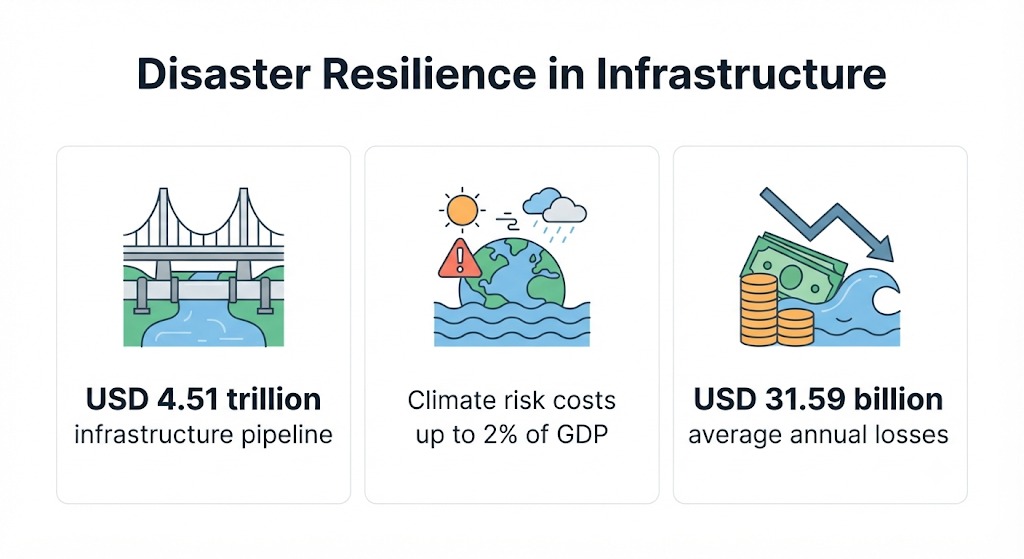
Consider the following statements regarding the 'Mainstreaming Disaster Resilience into Infrastructure Project Report': The report is a strategic study published by the Coalition for Disaster Resilient Infrastructure (CDRI) in collaboration with India's Ministry of Finance. It focuses primarily on embedding climate-risk evaluations into the National Infrastructure Pipeline (NIP), with special emphasis on the power, transport, and road sectors. Which of the statements given above is/are correct?
- 1 only
- 2 only
- Both 1 and 2
- Neither 1 nor 2
Practice questions are answered inside your account. Create a free account, or see what practice includes.
With reference to the economic and fiscal impact of natural hazards on India as highlighted in recent resilience assessments, consider the following statements: Average annual damages to infrastructure assets from disasters cost India roughly USD 31.59 billion. Natural hazards have the capacity to lower yearly GDP by up to 5% and reduce government revenues by 25%. Which of the statements given above is/are correct?
- 1 only
- 2 only
- Both 1 and 2
- Neither 1 nor 2
Practice questions are answered inside your account. Create a free account, or see what practice includes.
Which of the following best describes the returns observed from initial trials of the Resilience Cost-Benefit Analysis (CBA) instrument mentioned in disaster resilience infrastructure frameworks?
- Returns of up to 2 times the initial investment
- Returns of up to 5 times the initial investment
- Returns of up to 12 times the initial investment
- Returns of up to 25 times the initial investment
Practice questions are answered inside your account. Create a free account, or see what practice includes.
Regarding the recommendations put forward to enhance disaster resilience in Indian infrastructure, which of the following measures is suggested to ensure more precise risk distribution?
- Eliminating Force Majeure provisions entirely from all public-private partnership contracts
- Connecting Force Majeure provisions to quantifiable hazard criteria such as definite flood levels or wind speeds
- Relying exclusively on post-disaster evaluations for budget management
- Transferring all long-term reconstruction liabilities completely to the National Disaster Response Fund
Practice questions are answered inside your account. Create a free account, or see what practice includes.