India’s EV Ambition Needs A Grid Strategy↗
20 May 2026
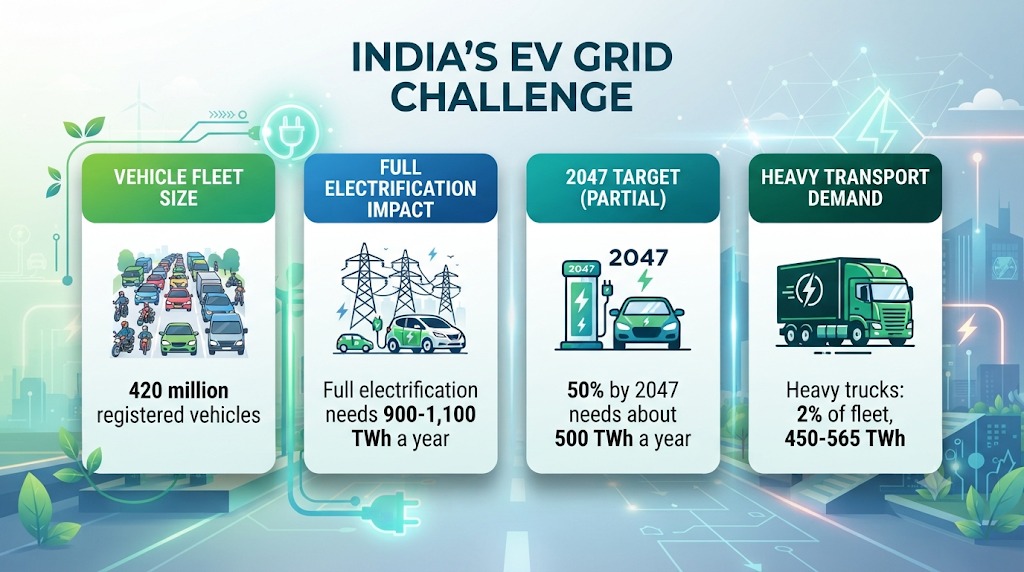
Consider the following statements regarding India's power capacity and projected electricity demand for electric vehicle (EV) adoption: Fully electrifying India's entire registered vehicle fleet would require an additional 900 TWh to 1,100 TWh of electricity annually. Converting a moderate 50% vehicle share by 2047 will require an additional 500 TWh annually. Heavy Goods Vehicles account for barely 2% of the total registered national fleet, yet their electrification will consume over 450 TWh yearly due to high energy intensity. Which of the statements given above are correct?
- 1 and 2 only
- 2 and 3 only
- 1 and 3 only
- 1, 2 and 3
Practice questions are answered inside your account. Create a free account, or see what practice includes.
With reference to the PM-E-DRIVE Scheme mentioned in recent policy frameworks, what is its primary objective?
- To provide direct financial subsidies to encourage electric vehicle adoption, with a strong emphasis on high-impact segments such as e-buses and commercial trucks
- To expand the national power transmission grid to 6.48 lakh circuit kilometers by 2032
- To install smart meters across all state distribution companies under the Revamped Distribution Sector Scheme
- To mandate global-first, India-centric Dual Plugin Charging Standards for all private passenger vehicles
Practice questions are answered inside your account. Create a free account, or see what practice includes.
Consider the following initiatives and bodies associated with India's power and transport sectors: Revamped Distribution Sector Scheme (RDSS): Deployed millions of smart meters to establish the foundation for digital, real-time consumption tracking. Bureau of Indian Standards (BIS): Notified a global-first, India-centric Dual Plugin Charging Standard for e-buses. National Electricity Plan: Revised transmission blueprints targeting grid expansion to 6.48 lakh circuit kilometers by 2032. Which of the statements given above are correct?
- 1 and 2 only
- 2 and 3 only
- 1 and 3 only
- 1, 2 and 3
Practice questions are answered inside your account. Create a free account, or see what practice includes.
In the context of India's evolving clean mobility landscape, what does the 'Coal Displacement Trap' refer to?
- The heavy financial strain experienced by cash-constrained state distribution companies when upgrading regional transformers
- The geographical disparity where advanced renewable integration remains concentrated in leading states like Karnataka
- The risk that powering a green vehicle transition through thermal generation merely shifts the carbon footprint from tailpipes to smokestacks, substituting oil imports with coal imports
- The administrative delays encountered by fleet operators when attempting to establish high-tension depot connections
Practice questions are answered inside your account. Create a free account, or see what practice includes.