Why Strong El Niño Does Not Always Cause Drought?
3 Nov 2026
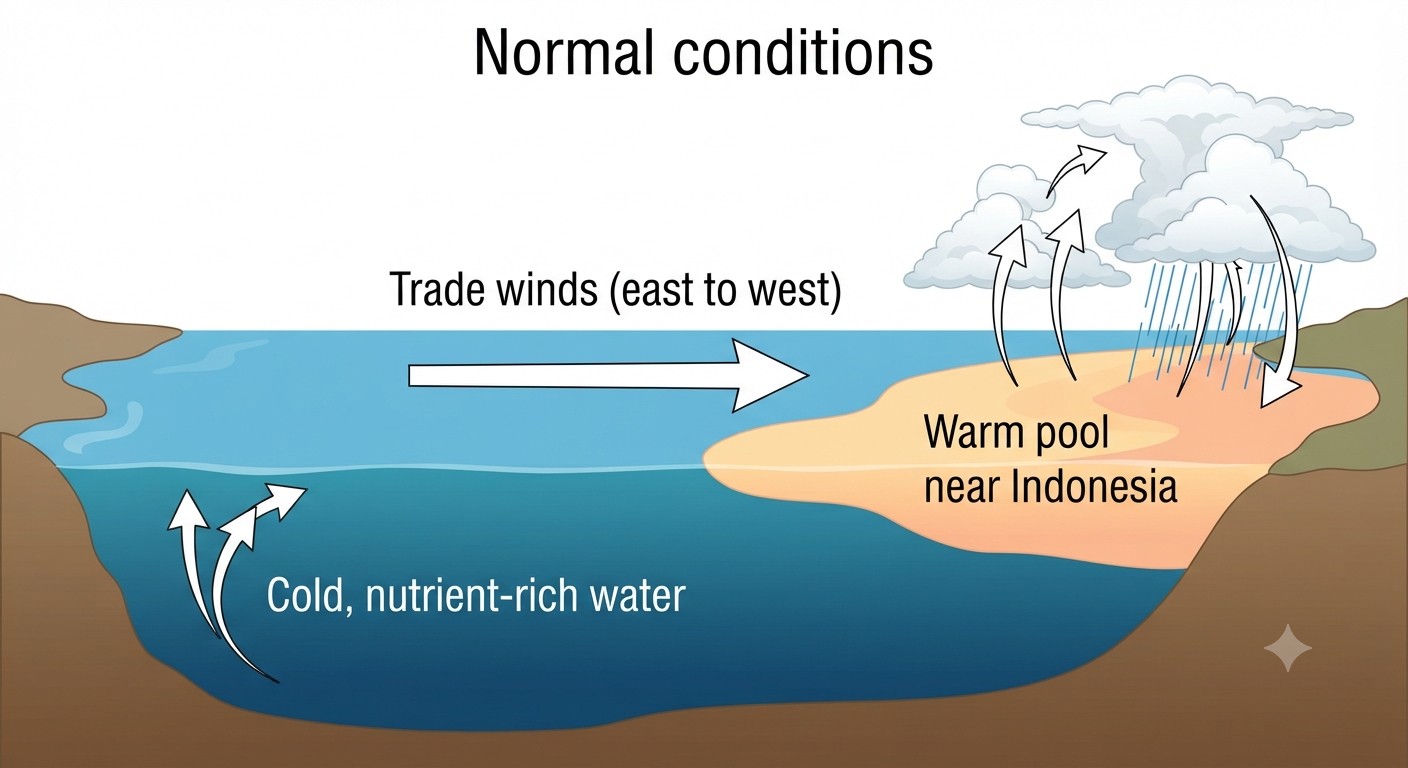
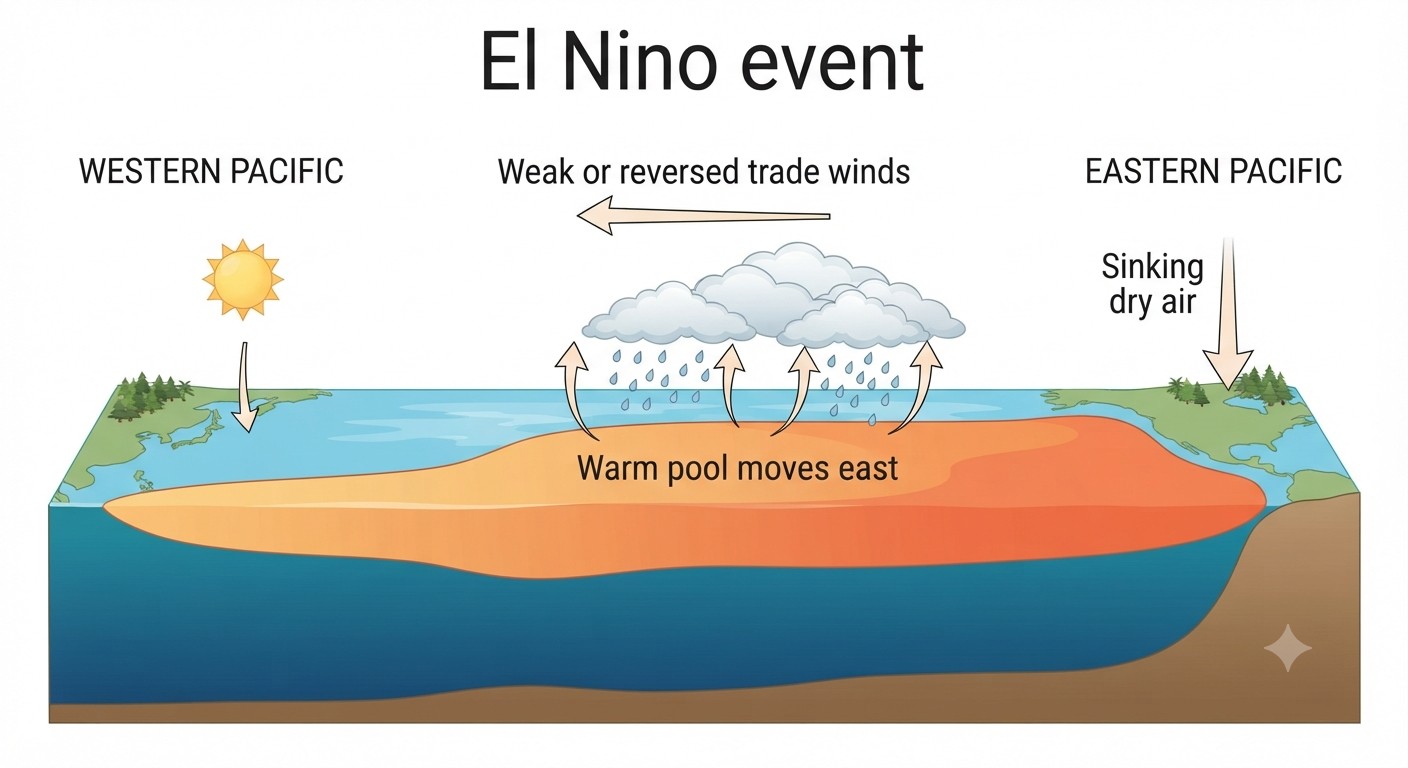
Consider the following factors that can prevent a strong El Niño from causing a drought in India: A strong positive Indian Ocean Dipole The location of the Pacific warm pool in the far east (canonical El Niño) Mid-latitude systems such as abnormal high-pressure ridges above the Iranian plateau Which of the factors given above are cited as counterbalancing influences?
- 1 and 2 only
- 2 and 3 only
- 1 and 3 only
- 1, 2 and 3
Practice questions are answered inside your account. Create a free account, or see what practice includes.
According to historical records and data regarding El Niño and the Indian monsoon since 1950, which of the following best reflects the statistical relationship?
- Every single El Niño year without exception has resulted in a severe drought in India.
- Out of seven moderate or strong El Niño years since 1950, five have been reported as years of deficient monsoon in India.
- El Niño has historically shown zero correlation with monsoon rainfall performance in India.
- Strong El Niño events exclusively result in above-average rainfall due to the counter-effect of the Walker circulation.
Practice questions are answered inside your account. Create a free account, or see what practice includes.
What is the Madden-Julian Oscillation (MJO) described as in meteorological terms?
- A permanent stationary high-pressure ridge over the Iranian plateau
- A planetary-scale wave of cloud and rain that moves around the tropics every 30 to 60 days
- A multi-year sea surface temperature oscillation restricted entirely to the equatorial Atlantic
- A surface current system that drives cold water off South America's western coast
Practice questions are answered inside your account. Create a free account, or see what practice includes.
In the context of Pacific warming patterns, how does 'El Niño Modoki' differ from a canonical El Niño in its impact on the Indian monsoon?
- El Niño Modoki centers Pacific warming in the far east near South America, shifting descending air away from South Asia.
- El Niño Modoki places the warmest water in the Central Pacific, settling dry descending air directly over India and increasing drought likelihood.
- El Niño Modoki consistently triggers a positive Indian Ocean Dipole, neutralizing any monsoon deficit.
- El Niño Modoki prevents any formation of descending air branches over the tropical loop.
Practice questions are answered inside your account. Create a free account, or see what practice includes.
Consider the following statements regarding the Indian Ocean Dipole (IOD): A positive IOD is characterized by warmer water in the western part of the Indian Ocean near Africa. A positive IOD helps offset the drying influence of El Niño by carrying extra moisture across the Arabian Sea. Which of the statements given above is/are correct?
- 1 only
- 2 only
- Both 1 and 2
- Neither 1 nor 2
Practice questions are answered inside your account. Create a free account, or see what practice includes.