Constitutional Limits on Arrest
14 Aug 2026
Consider the following statements regarding the constitutional safeguards on arrest in India: The requirement to produce an arrested person before the nearest magistrate within 24 hours excludes the time necessary for the journey from the place of arrest to the court. Article 22(1) allows police to satisfy the requirement of communicating grounds of arrest by notifying the close relatives of the accused if the accused is uncooperative. Which of the statements given above is/are correct?
- 1 only
- 2 only
- Both 1 and 2
- Neither 1 nor 2
Practice questions are answered inside your account. Create a free account, or see what practice includes.
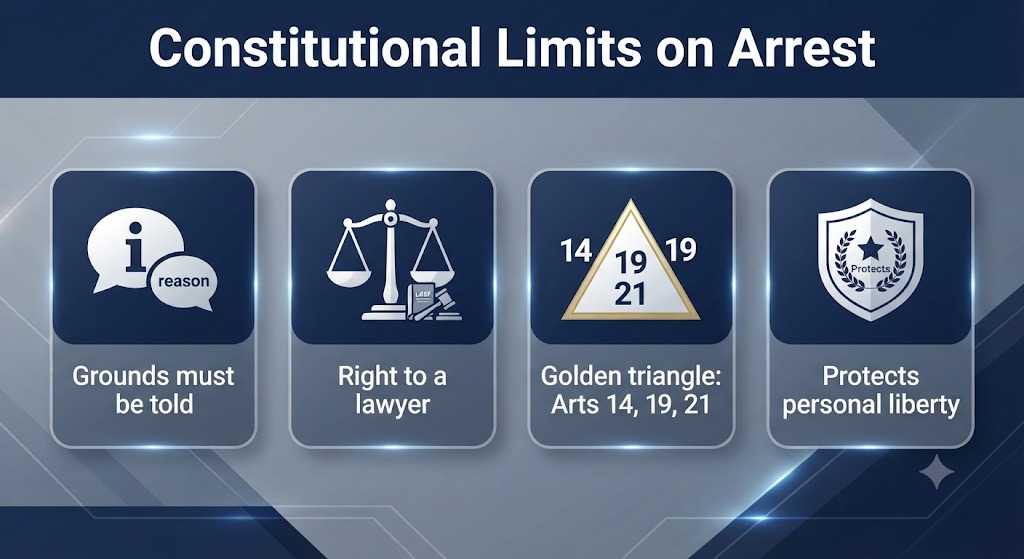
Which of the following landmark Supreme Court rulings formulated the 'Golden Triangle' doctrine, connecting Articles 14, 19, and 21 of the Constitution?
- D.K. Basu v. State of West Bengal
- Maneka Gandhi v. Union of India
- Arnesh Kumar v. State of Bihar
- Vihaan Kumar v. State of Haryana
Practice questions are answered inside your account. Create a free account, or see what practice includes.
Consider the following statements regarding the guidelines established in Arnesh Kumar v. State of Bihar (2014): Arrests should be treated as an exception in cases where offences carry a punishment of less than seven years imprisonment. Police officers are required to explicitly satisfy and document the necessity of custody under statutory provisions before executing an arrest for such offences. Which of the statements given above is/are correct?
- 1 only
- 2 only
- Both 1 and 2
- Neither 1 nor 2
Practice questions are answered inside your account. Create a free account, or see what practice includes.
Which of the following represents a fundamental distinction between ordinary arrest and preventive detention under Indian law?
- Preventive detention permits detention for up to 3 months without Advisory Board approval, whereas ordinary arrest requires production before a magistrate within 24 hours.
- Preventive detention includes full procedural safeguards like legal counsel and grounds of detention, whereas ordinary arrest excludes them.
- Ordinary arrest is a non-punitive administrative action, whereas preventive detention is based on probable cause that an offence was committed.
- Ordinary arrest applies exclusively to non-cognizable offences, whereas preventive detention applies only to bailable offences.
Practice questions are answered inside your account. Create a free account, or see what practice includes.