Section 17A of the Prevention of Corruption Act, 1988
22 Jan 2026
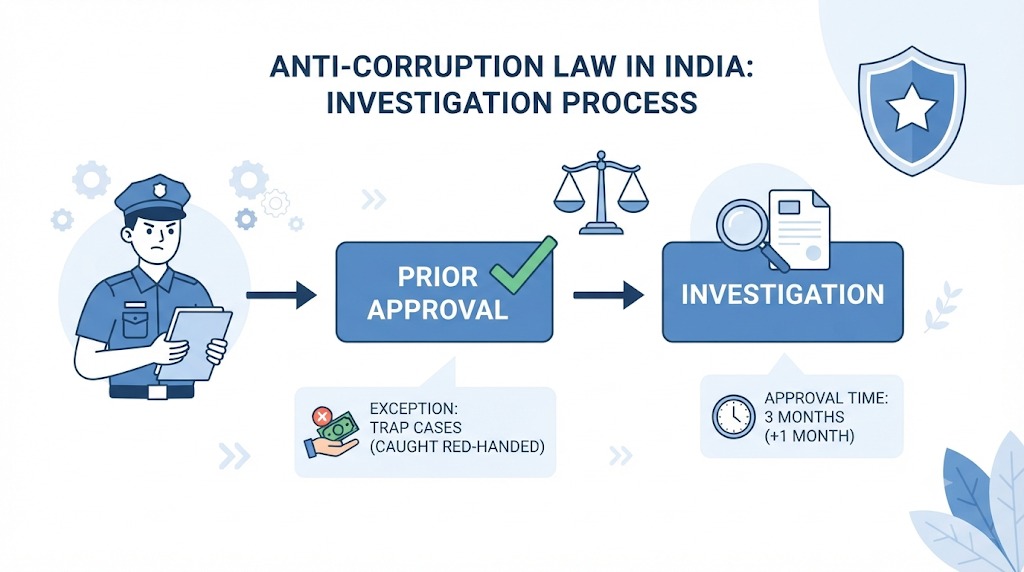
With reference to Section 17A of the Prevention of Corruption Act, 1988, consider the following statements: It was inserted into the principal Act by the Prevention of Corruption (Amendment) Act, 2018. It mandates prior approval from the competent authority for conducting an inquiry or investigation into offences relatable to any recommendation made by a public servant in the discharge of official functions. Trap cases where a public servant is caught red-handed accepting a bribe do not require prior approval under this section. Which of the statements given above are correct?
- 1 and 2 only
- 2 and 3 only
- 1 and 3 only
- 1, 2 and 3
Practice questions are answered inside your account. Create a free account, or see what practice includes.
What is the primary difference between Section 17A and Section 19 of the Prevention of Corruption Act, 1988?
- Section 17A applies only to Central government employees, whereas Section 19 applies to State employees.
- Section 17A mandates approval strictly at the investigation stage, whereas Section 19 mandates sanction strictly at the prosecution stage.
- Section 17A permits investigations without judicial oversight, whereas Section 19 requires high court permission.
- Section 17A was introduced in 1988, whereas Section 19 was added by the 2018 amendment.
Practice questions are answered inside your account. Create a free account, or see what practice includes.
Under Section 17A of the Prevention of Corruption Act, 1988, what is the statutory time limit prescribed for the competent authority to process a request for prior approval to investigate?
- One month, extendable by another month
- Two months, non-extendable
- Three months, which can be extended by one month with recorded reasons
- Six months, extendable by three months
Practice questions are answered inside your account. Create a free account, or see what practice includes.
In the judicial trajectory concerning prior approval requirements for investigating corruption charges against public servants, the Supreme Court in the landmark Vineet Narain vs Union of India (1998) case invalidated which of the following?
- Section 6A of the Delhi Special Police Establishment (DSPE) Act
- The Single Directive, which mandated prior approval for investigating senior bureaucrats
- Section 17A of the Prevention of Corruption Act, 1988
- The constitutional validity of the Central Vigilance Commission Act
Practice questions are answered inside your account. Create a free account, or see what practice includes.
Regarding the recent Supreme Court split verdict on the constitutional validity of Section 17A of the Prevention of Corruption Act, 1988, which of the following accurately describes the stance taken by Justice K. V. Viswanathan?
- Declared Section 17A completely unconstitutional as 'old wine in a new bottle'
- Validated Section 17A with conditions, emphasizing safeguards for honest officers and suggesting approval be channeled through bodies like the Lokpal
- Held that prior approval should be completely abolished for all public servants without exception
- Ruled that Section 17A applies exclusively to members of the judiciary and legislature
Practice questions are answered inside your account. Create a free account, or see what practice includes.