The Central Excise (Amendment) Act, 2025
2 Jan 2026
- July 2017
Introduction of GST Compensation Cess
- June 2022
Original Expiration Reached
- March 2026
Extended Cess Termination
- February 2025
Enactment of the Amendment Act
- February 2026
Full Implementation
With reference to the Central Excise (Amendment) Act, 2025, which of the following best describes the primary rationale behind restructuring excise levies and modifying GST rates on tobacco products?
- To completely ban the cultivation and manufacturing of all tobacco derivatives in India by 2026
- To offset the expiration of the GST compensation cess and align with public health mandates by elevating prices
- To bring all categories of unmanufactured and manufactured tobacco directly under the lowest 5% GST slab
- To eliminate central excise duties entirely on tobacco and replace them with a unified state-level tax
Practice questions are answered inside your account. Create a free account, or see what practice includes.
Consider the changes introduced under the Central Excise (Amendment) Act, 2025 regarding tariff hikes on tobacco goods. Which category witnessed the steepest percentage-point increase in central excise duty?
- Unmanufactured tobacco (from 64% to 70%)
- Chewing tobacco (from 25% to 100%)
- Hookah and gudaku tobacco (from 25% to 40%)
- Smoking mixtures intended for pipes and cigarettes (from 60% to 325%)
Practice questions are answered inside your account. Create a free account, or see what practice includes.
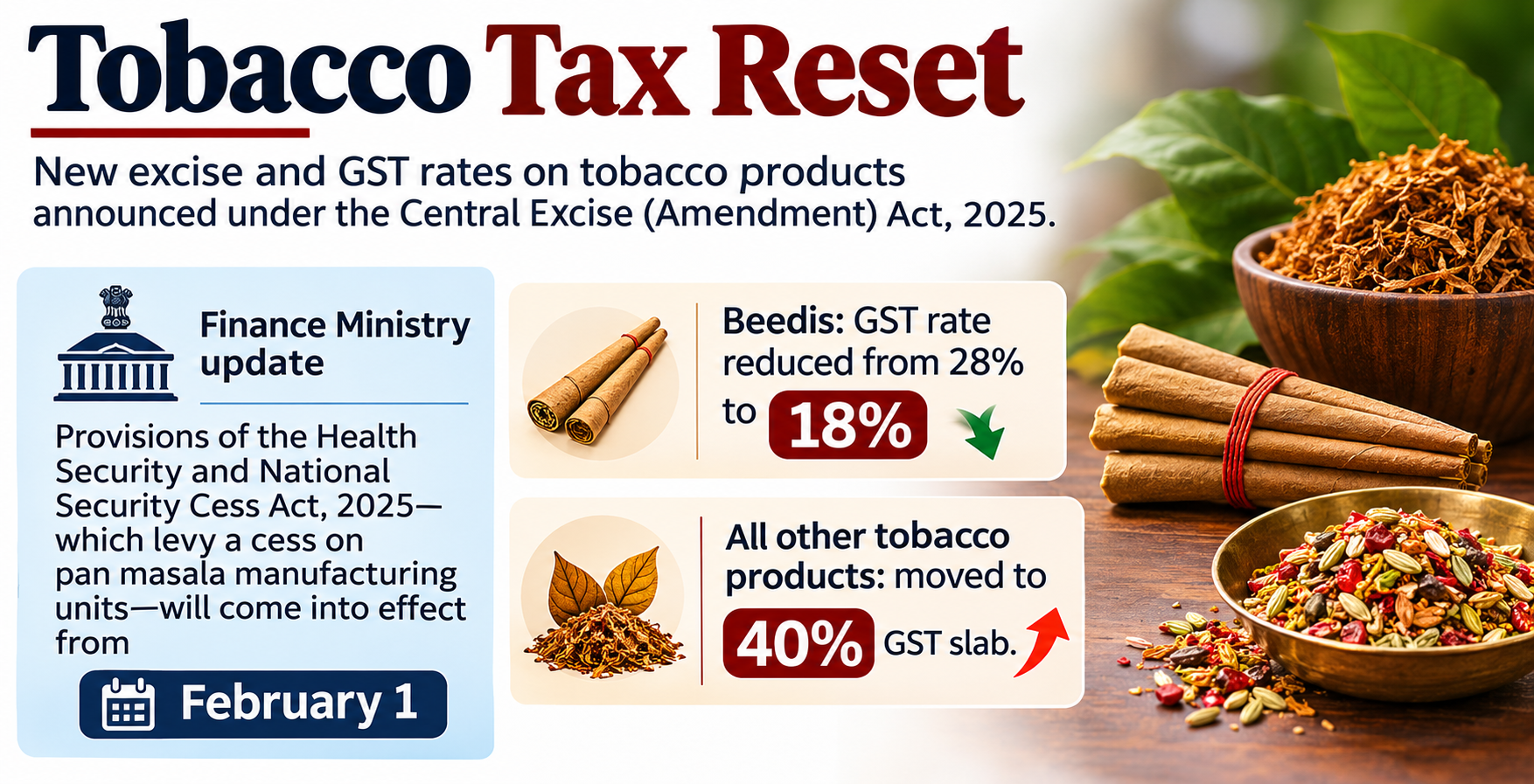
Following the implementation of the recent tax adjustments and the withdrawal of the GST compensation cess, how have beedis and remaining tobacco goods been reclassified under the GST regime?
- Beedis are reclassified under the 18% GST tier, and all remaining tobacco goods under the 40% GST tier
- Beedis are exempted from GST entirely, while remaining tobacco goods are placed in the 28% slab
- Both beedis and all other tobacco goods are uniformly subjected to a 40% GST rate
- Beedis are placed under the 5% tier, while remaining tobacco goods fall under the 18% tier
Practice questions are answered inside your account. Create a free account, or see what practice includes.
What is the revised valuation framework introduced for assessing GST on specific tobacco products such as chewing tobacco, gutkha, khaini, and jarda?
- Assessment based solely on the cost of raw materials at the farm gate
- Assessment based on the Maximum Retail Price (MRP) printed on packaging
- Assessment calculated through a flat-rate specific duty per kilogram irrespective of brand
- Assessment determined by the export value declared at international borders
Practice questions are answered inside your account. Create a free account, or see what practice includes.
Regarding the GST compensation cess, which of the following statements accurately reflects its chronology and operational scope?
- It was introduced permanently in 2017 with no expiration date and applies exclusively to agricultural produce.
- It was originally mandated for five years through June 2022, subsequently prolonged through March 31, 2026, to cover pandemic-induced revenue gaps.
- It was abolished in 2020 and replaced entirely by direct income support schemes for State governments.
- It is charged solely on software services and IT exports to compensate States for digital infrastructure costs.
Practice questions are answered inside your account. Create a free account, or see what practice includes.