Corporate Governance in India
8 Apr 2026
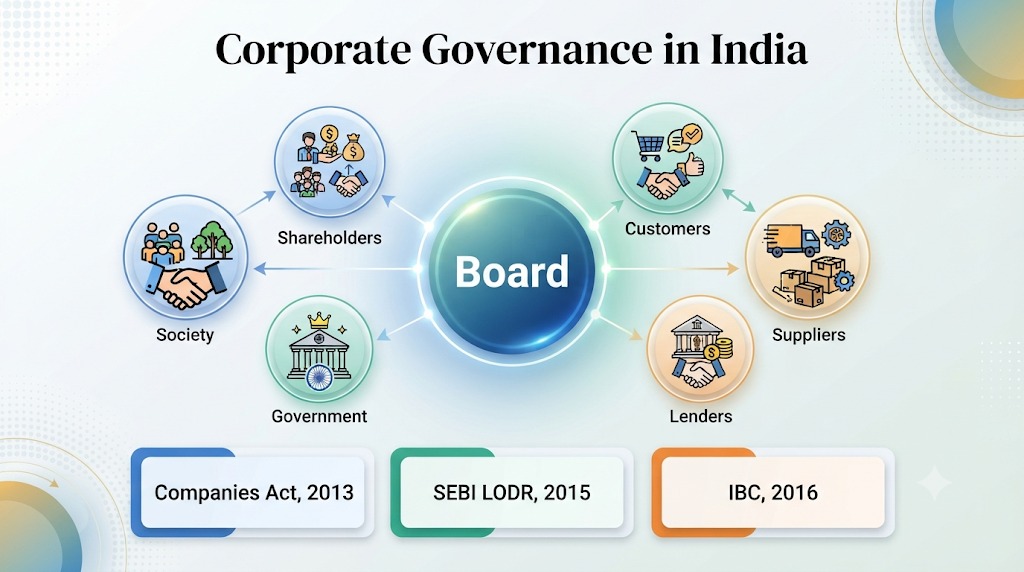
Consider the following statements regarding the regulatory framework for corporate governance in India: The Companies Act, 2013 introduced compulsory mandates for female directors and independent board members. The Insolvency and Bankruptcy Code (IBC), 2016 transfers authority from the lender to the borrower upon insolvency to protect promoters. The SEBI (LODR) Regulations, 2015 establish an exhaustive system concerning transparency, board structure, and investor entitlements for publicly traded firms. Which of the statements given above are correct?
- 1 and 2 only
- 1 and 3 only
- 2 and 3 only
- 1, 2 and 3
Practice questions are answered inside your account. Create a free account, or see what practice includes.
Which of the following is highlighted as a primary obstacle facing corporate governance in India?
- Excessive shareholder activism by retail investors disrupting daily operations
- The check-box approach where governance is treated as a compliance chore rather than an internal culture
- Complete prohibition of Related Party Transactions under current commercial statutes
- An oversupply of genuine independent directors leading to boardroom gridlock
Practice questions are answered inside your account. Create a free account, or see what practice includes.
According to the statements made at the 19th CII Corporate Governance Summit by the SEBI Chairman, what forms the true standard of corporate governance beyond regulatory structures?
- Strict enforcement of penal actions by market regulators
- The proactive responsibility and careful oversight exercised by board management and independent directors
- Automated filing systems utilizing Big Data and AI
- Mandatory alignment of executive compensation with short-term market capitalization
Practice questions are answered inside your account. Create a free account, or see what practice includes.