Understanding Inequality in India’s Growth Story↗
7 May 2026
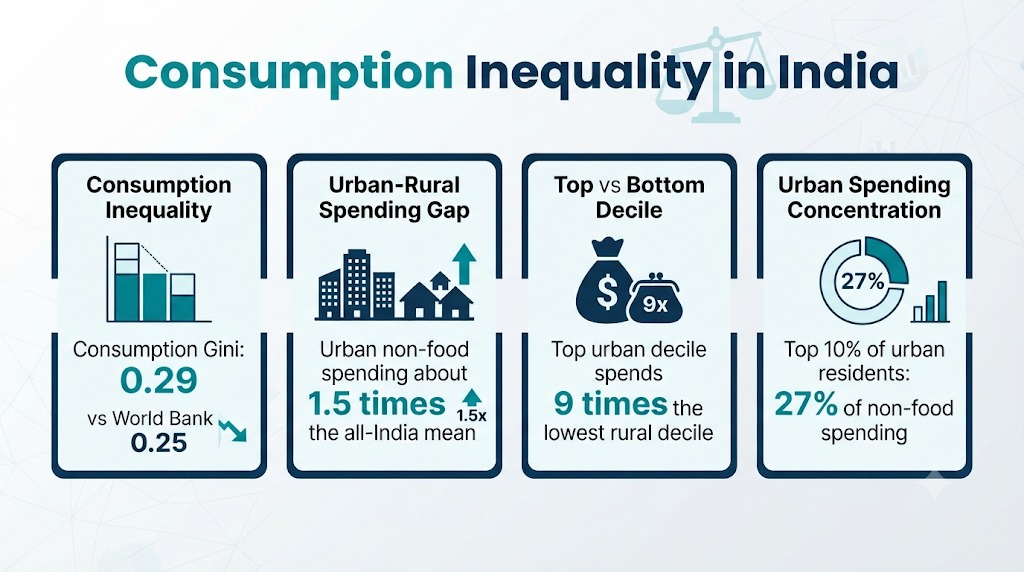
Consider the following statements regarding the consumption inequality metrics in India based on recent analysis: The consumption Gini index from the HCES 2023-24 is projected at 0.29, which is higher than the World Bank metric of 0.25. The average monthly per capita expenditure (MPCE) of the highest urban decile stands at nine times that of the lowest rural decile. Which of the statements given above is/are correct?
- 1 only
- 2 only
- Both 1 and 2
- Neither 1 nor 2
Practice questions are answered inside your account. Create a free account, or see what practice includes.
Which of the following legislative acts is introduced to succeed MGNREGA by establishing a new framework for rural employment and livelihoods?
- Pradhan Mantri Garib Kalyan Yojana
- Viksit Bharat-Guarantee for Rozgar and Ajeevika Mission (Gramin) Bill, 2025
- National Rural Livelihoods Promotion Act
- New Labour Codes Consolidation Act
Practice questions are answered inside your account. Create a free account, or see what practice includes.
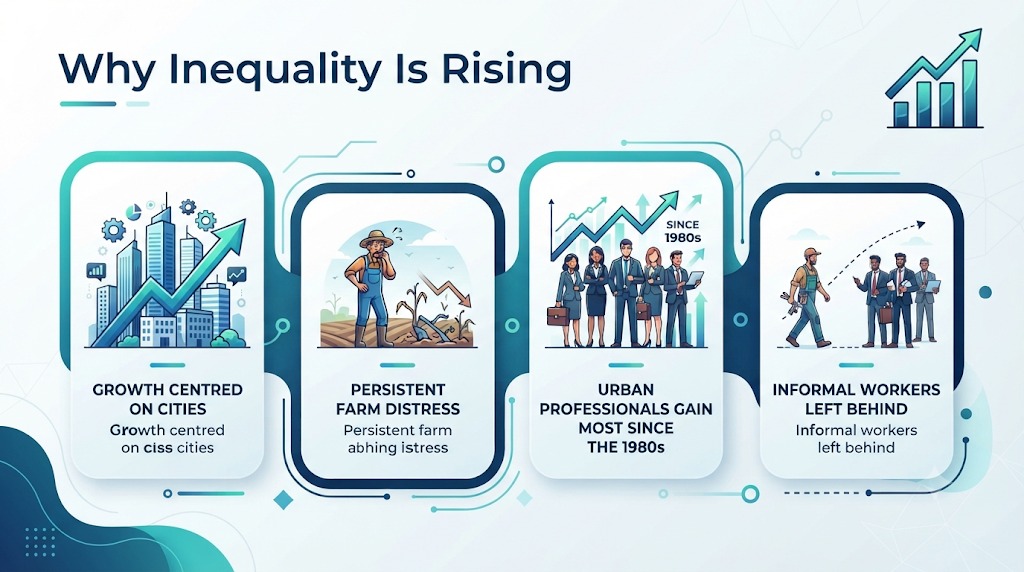
With reference to structural economic shifts and inequality in India, consider the following factors: Urban-centric growth models leaving behind rural domains Persistent agricultural distress stretching the income divide Systemic income growth and upward mobility among urban informal and farm workers Which of the above factors are identified as reasons for the rise in inequality?
- 1 and 2 only
- 2 and 3 only
- 1 and 3 only
- 1, 2 and 3
Practice questions are answered inside your account. Create a free account, or see what practice includes.
What is the primary reason standard household consumption surveys (such as the HCES) tend to understate the true level of economic inequality in India?
- They completely exclude all urban residents from the sampling frame.
- They frequently fail to record the consumption and assets of the superrich segment.
- They only account for non-food expenditure while ignoring food consumption entirely.
- They overestimate rural incomes by failing to adjust for inflation.
Practice questions are answered inside your account. Create a free account, or see what practice includes.
Consider the following statements regarding the implications of inequality on India's economic growth: Underestimating disparity through lower Gini index metrics can lead to the under-funding of essential rural support networks. A reliance on debt-driven consumption by informal personnel helps ensure long-term, stable economic expansion. Which of the statements given above is/are correct?
- 1 only
- 2 only
- Both 1 and 2
- Neither 1 nor 2
Practice questions are answered inside your account. Create a free account, or see what practice includes.