Space Re-entry
2 Mar 2026
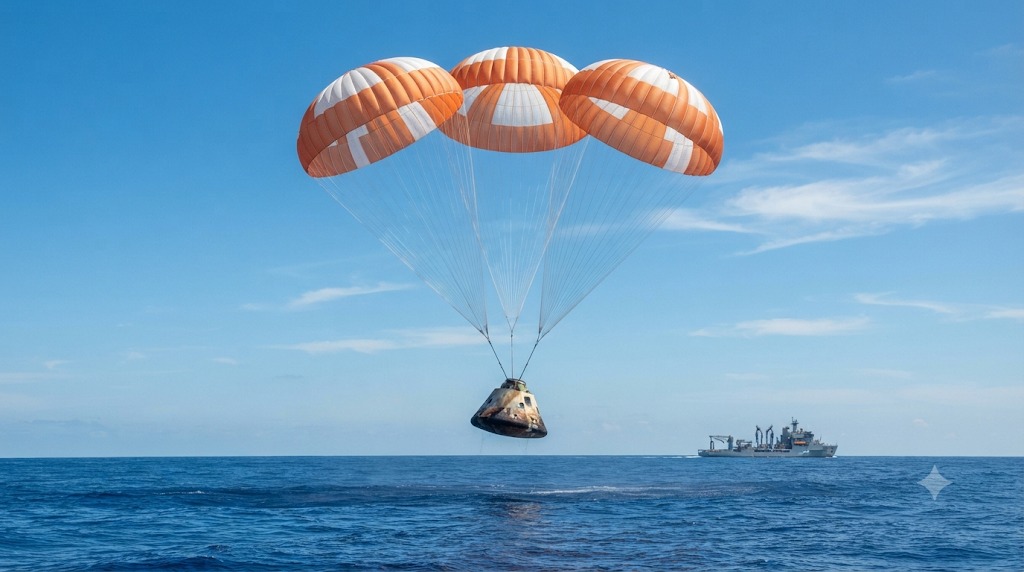
Consider the following statements regarding the atmospheric re-entry of a spacecraft: If the entry angle is too shallow, the vehicle risks bouncing off the atmosphere back into space. If the entry angle is too steep, it results in extreme heat and severe deceleration forces that can disintegrate the craft. Which of the statements given above is/are correct?
- 1 only
- 2 only
- Both 1 and 2
- Neither 1 nor 2
Practice questions are answered inside your account. Create a free account, or see what practice includes.
What is the primary cause of a communication blackout during a spacecraft's atmospheric re-entry?
- Interference from dense cloud cover in the upper stratosphere
- Intense heat ionising the surrounding air to form a plasma barrier that blocks radio frequencies
- Deliberate jamming of radio transmissions by onboard systems to protect sensitive telemetry
- Failure of the spacecraft's primary antenna due to extreme aerodynamic drag
Practice questions are answered inside your account. Create a free account, or see what practice includes.
In the context of spacecraft design and re-entry dynamics, what characterizes a 'semi-ballistic body'?
- It possesses the full aerodynamic steerability and landing capabilities of a conventional airplane.
- It is a completely passive falling mass incapable of making any trajectory adjustments.
- It lacks airplane-like full steerability but can produce a degree of aerodynamic lift and drag to execute minor trajectory adjustments.
- It uses continuous jet propulsion throughout descent to maintain a fixed altitude above the atmosphere.
Practice questions are answered inside your account. Create a free account, or see what practice includes.
Regarding India's Gaganyaan mission architecture, where is the designated recovery site for the Crew Module's final splashdown?
- Arabian Sea
- Indian Ocean
- Bay of Bengal
- Andaman Sea
Practice questions are answered inside your account. Create a free account, or see what practice includes.