India’s E20 Ethanol Blending: Are the Economic and Environmental Gains Delivering?
17 Sept 2026
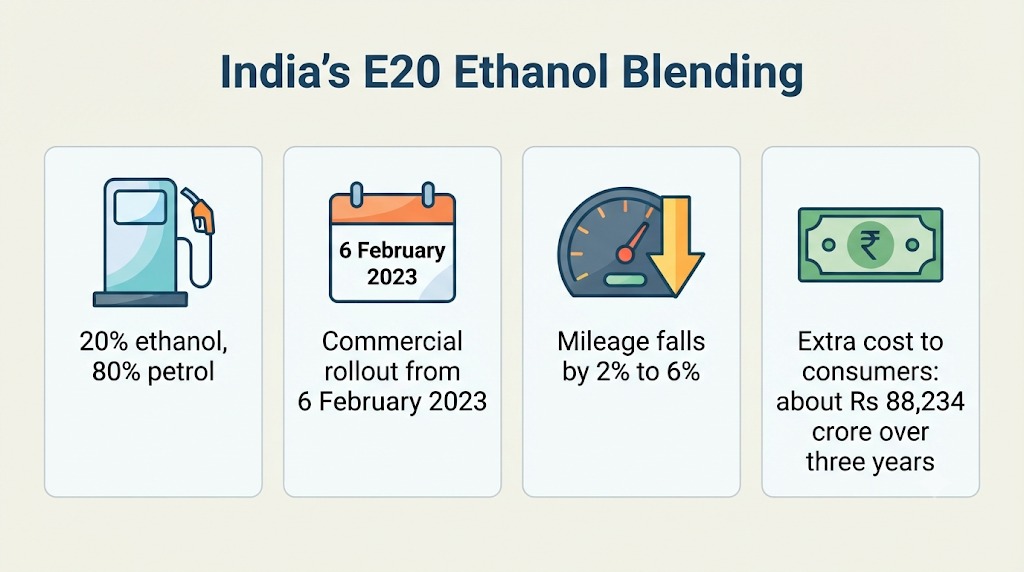
Consider the following statements regarding India's E20 Ethanol Blended Petrol (EBP) Programme: E20 fuel comprises 20% anhydrous ethanol and 80% traditional fossil gasoline. Testing by automotive bodies indicates that E20 lowers fuel efficiency by 2% to 6% across various vehicle types. Retail public sector Oil Marketing Companies (OMCs) universally reduced pump prices of E20 in proportion to its lower volumetric energy density. Which of the statements given above is/are correct?
- 1 and 2 only
- 2 and 3 only
- 1 and 3 only
- 1, 2 and 3
Practice questions are answered inside your account. Create a free account, or see what practice includes.
What is the '4% Emissions Inversion Point' in the context of high-blend ethanol fuel usage?
- The threshold where vehicle speed drops by more than 4% due to engine knocking.
- The point where the increased volume of fuel burned to compensate for lower energy density outweighs ethanol's lower carbon density, causing net emissions to rise.
- The mandatory minimum percentage of water contamination allowed in ethanol storage tanks before corrosion begins.
- The governmental fiscal target for reducing crude oil import bills through biofuel blending.
Practice questions are answered inside your account. Create a free account, or see what practice includes.
Which of the following problems is directly associated with the hygroscopic nature of ethanol used in motor fuels?
- Rapid depletion of groundwater tables in sugarcane-growing states.
- Conversion of India from a net exporter to a net importer of maize.
- Attraction of moisture from the air, causing water accumulation, rust in metal tanks, and degradation of standard rubber gaskets.
- Immediate increase in retail food price inflation for dairy and poultry products.
Practice questions are answered inside your account. Create a free account, or see what practice includes.
With reference to India's biofuel policy challenges, what is the primary advantage of shifting focus from first-generation (1G) biofuels to second-generation (2G) biofuels such as paddy straw?
- It completely eliminates the need for any chemical processing or distillation plants.
- It resolves the food security conflict by utilizing non-food biomass while simultaneously addressing stubble burning.
- It ensures that vehicles experience zero drop in fuel efficiency compared to pure gasoline.
- It allows sugarcane and maize farmers to receive higher export subsidies from the government.
Practice questions are answered inside your account. Create a free account, or see what practice includes.
Consider the following outcomes linked to the implementation of the E20 blending mandate in India: Cumulative extra financial burden on consumers due to reduced volumetric fuel efficiency. Loss of agricultural export earnings due to state-directed export bans on sugarcane and increased maize imports. Immediate availability of dual-dispenser pumps at all fuel stations for pre-2023 legacy vehicles. Which of the statements given above are correct?
- 1 and 2 only
- 2 and 3 only
- 1 and 3 only
- 1, 2 and 3
Practice questions are answered inside your account. Create a free account, or see what practice includes.