National Commission for Women marks its 34th Foundation Day
31 Jan 2026
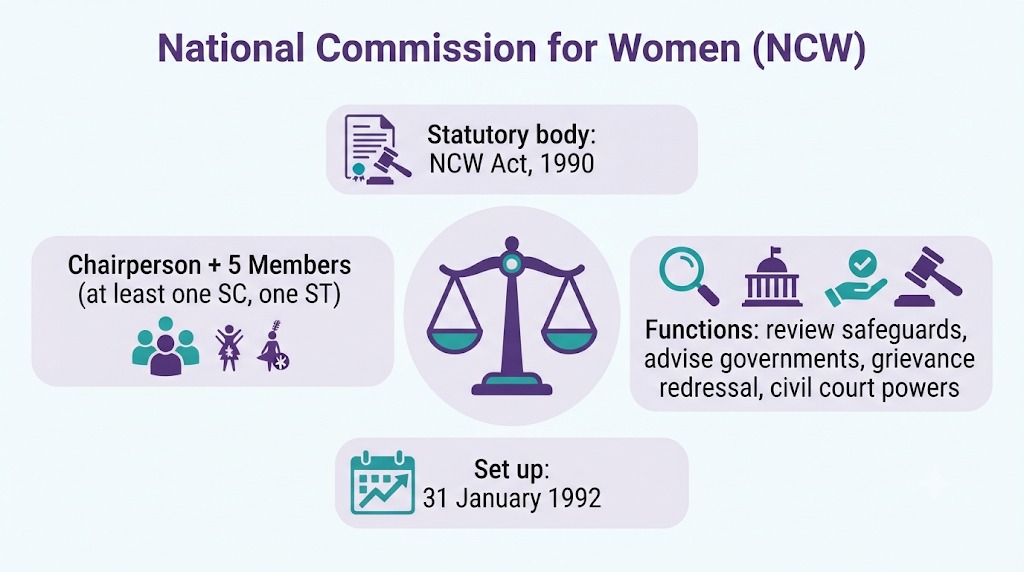
Consider the following powers and functions of the National Commission for Women: It has the powers of a civil court while investigating or inquiring into any matter. It can take independent (suo motu) cognizance of matters relating to the deprivation of women's rights. It has the power to directly prosecute and sentence offenders in criminal courts. Which of the statements given above are correct?
- 1 and 2 only
- 2 and 3 only
- 1 and 3 only
- 1, 2 and 3
Practice questions are answered inside your account. Create a free account, or see what practice includes.
According to Section 3 of the National Commission for Women Act, 1990, what is the mandatory reservation requirement regarding the members of the Commission?
- At least one member must belong to the Scheduled Castes and one to the Scheduled Tribes.
- At least fifty percent of the members must be women belonging to minority communities.
- At least two members must be sitting judges of a High Court.
- There is no mandatory caste or tribal reservation specified in the Act.
Practice questions are answered inside your account. Create a free account, or see what practice includes.
Which of the following historical bodies or plans initially proposed the creation of a central agency to oversee safeguards for women in India?
- The Committee on the Status of Women in India (CSWI)
- The Sarkaria Commission
- The First Administrative Reforms Commission
- The Balwant Rai Mehta Committee
Practice questions are answered inside your account. Create a free account, or see what practice includes.
Consider the following statements regarding the National Commission for Women (NCW): It is a constitutional body established under Article 356 of the Constitution of India. It was set up on 31 January 1992 in pursuance of the National Commission for Women Act, 1990. Which of the statements given above is/are correct?
- 1 only
- 2 only
- Both 1 and 2
- Neither 1 nor 2
Practice questions are answered inside your account. Create a free account, or see what practice includes.