Exoplanet WASP-94A b
5 Jun 2026
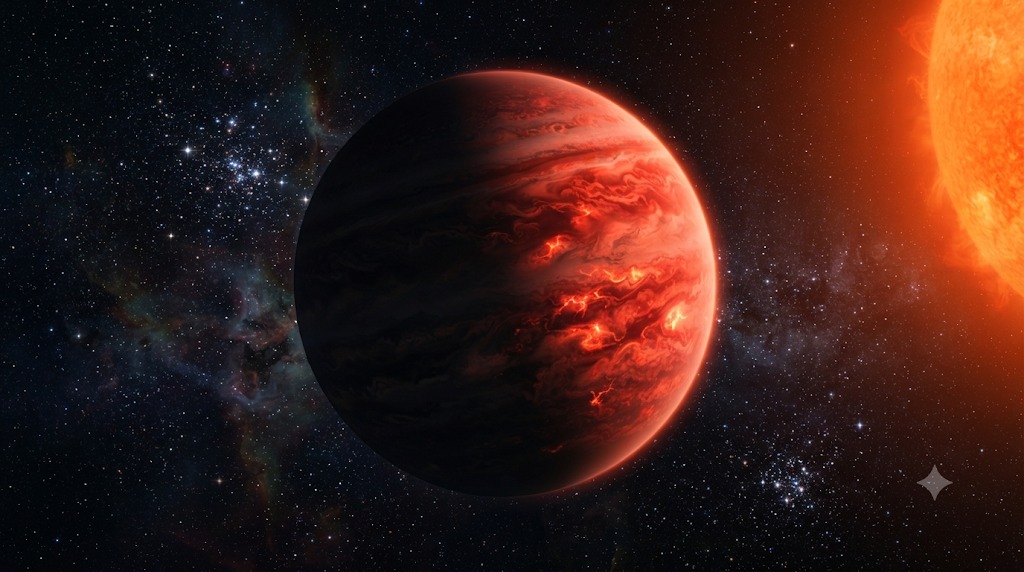
Consider the following statements regarding the exoplanet WASP-94A b: It is classified as a 'hot Jupiter' with a physical size larger than Jupiter but only half its mass. It completes one revolution around its host star in approximately four days. The planet exhibits uniform weather and temperature distribution across both hemispheres due to rapid rotation. Which of the statements given above are correct?
- 1 and 2 only
- 2 and 3 only
- 1 and 3 only
- 1, 2, and 3
Practice questions are answered inside your account. Create a free account, or see what practice includes.
With reference to the atmospheric features of WASP-94A b, consider the following statements: Heavy clouds composed of iron and magnesium silicates blanket the morning side of the planet. The early evening side of the planet typically displays clear skies. Which of the statements given above is/are correct?
- 1 only
- 2 only
- Both 1 and 2
- Neither 1 nor 2
Practice questions are answered inside your account. Create a free account, or see what practice includes.
Which space telescope was primarily utilized by researchers to chart the atmospheric weather dynamics and morning-and-evening weather patterns of WASP-94A b?
- Hubble Space Telescope
- James Webb Space Telescope
- Spitzer Space Telescope
- Chandra X-ray Observatory
Practice questions are answered inside your account. Create a free account, or see what practice includes.
Which of the following best describes the transit method used in observing the atmospheric profile of WASP-94A b?
- Measuring gravitational lensing effects as the planet passes behind its host star
- Split-scanning light across multiple wavelengths as the planet makes a slow transit across the face of the star
- Detecting direct radio emissions generated by the planet's strong magnetic field
- Analyzing reflected starlight directly captured during the planet's maximum elongation
Practice questions are answered inside your account. Create a free account, or see what practice includes.