Deep-Sea Mining in India: Critical Minerals and Ecological Challenges
19 Sept 2026
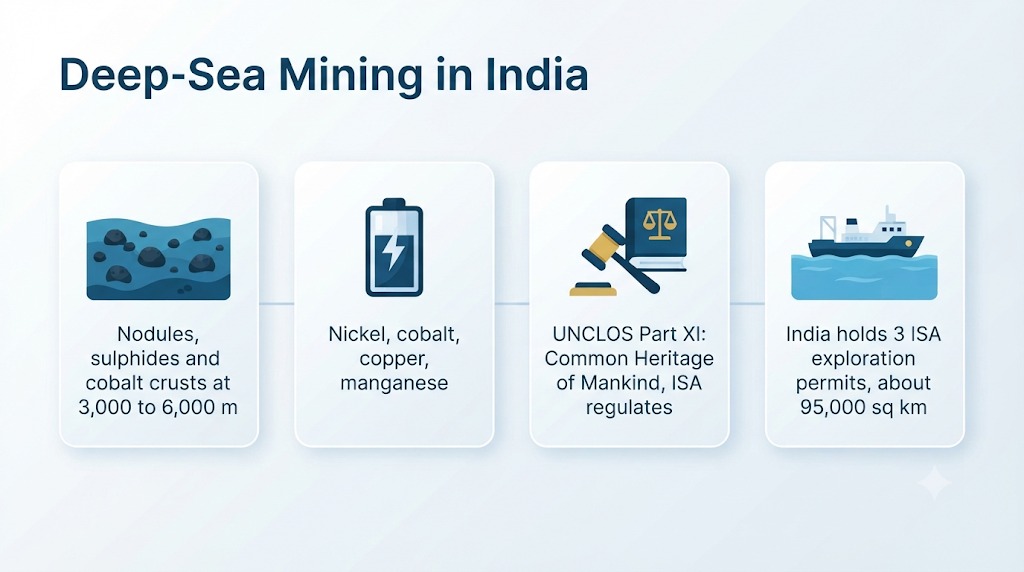
Consider the following statements regarding India's deep-sea exploration activities: India holds exploration permits issued by the International Seabed Authority (ISA) covering an area of approximately 95,000 square kilometres. These exploration zones are located exclusively in the Central Indian Ocean Basin. The National Institute of Ocean Technology (NIOT) has successfully tested a seabed extraction device at depths exceeding 5,000 metres. Which of the statements given above are correct?
- 1 and 2 only
- 1 and 3 only
- 2 and 3 only
- 1, 2 and 3
Practice questions are answered inside your account. Create a free account, or see what practice includes.
Under the international legal framework for deep-sea governance, what is the status of the regulatory code for seabed exploitation?
- The International Seabed Authority has fully finalized and adopted a binding Exploitation Code.
- The comprehensive exploitation code remains unfinalized, leaving commercial extraction rules unresolved.
- UNCLOS Part XI delegates all commercial extraction authority entirely to coastal states beyond national jurisdiction.
- The Mining Code has been superseded by regional treaties negotiated independently of the ISA.
Practice questions are answered inside your account. Create a free account, or see what practice includes.
Consider the following mineral deposits associated with deep-sea mining: Polymetallic nodules Polymetallic sulphides Cobalt-bearing ferromanganese crusts Which of these are explicitly identified as targets of deep-sea mining containing energy-transition materials like nickel, cobalt, copper, and manganese?
- 1 only
- 1 and 3 only
- 2 and 3 only
- 1, 2 and 3
Practice questions are answered inside your account. Create a free account, or see what practice includes.
According to the international legal architecture established by UNCLOS, how is the global seabed zone and its mineral wealth formally designated?
- As res nullius open to unilateral appropriation by any technologically advanced state
- As the exclusive economic property of the nearest coastal nation
- As the Common Heritage of Mankind regulated by the International Seabed Authority
- As a high-seas commons governed exclusively by customary international maritime law
Practice questions are answered inside your account. Create a free account, or see what practice includes.