500 Years of the First Battle of Panipat
21 Apr 2026
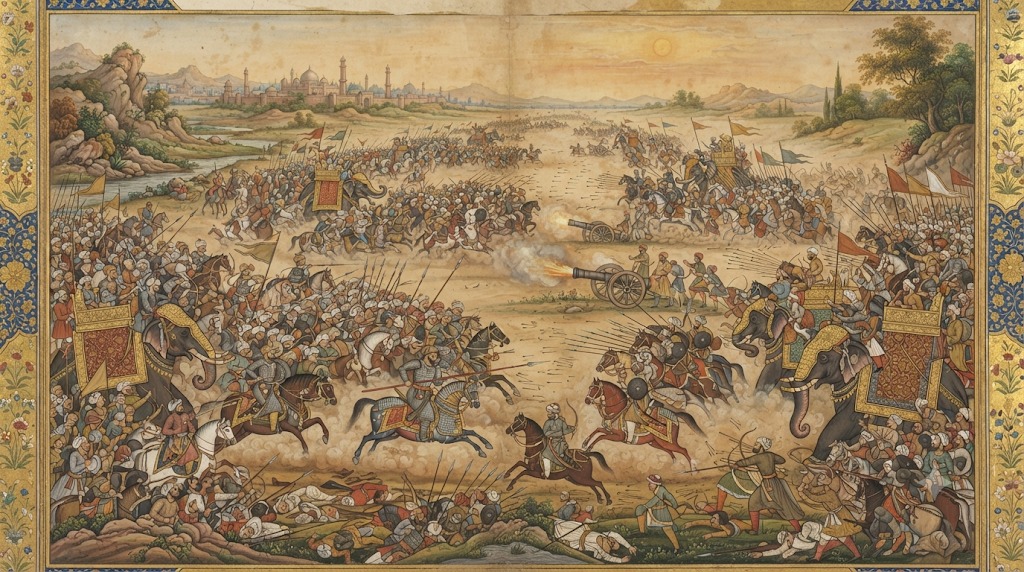
Consider the following statements regarding the First Battle of Panipat (1526): The engagement marked the end of the Delhi Sultanate and initiated Mughal rule in India. Babur’s army utilized the Tulughma strategy and Ottoman-style field firearms against the Lodi forces. Babur invaded India entirely on his own initiative without any invitation from local nobles. Which of the statements given above are correct?
- 1 and 2 only
- 2 and 3 only
- 1 and 3 only
- 1, 2 and 3
Practice questions are answered inside your account. Create a free account, or see what practice includes.
In the context of medieval Indian history, what was the significance of the Tulughma method employed during the First Battle of Panipat?
- It was a specialized naval blockade tactic used along the Yamuna river.
- It was an enveloping maneuver where flanking units circled the enemy to strike from the rear.
- It was a diplomatic treaty format used to partition territories among Rajput rulers.
- It was an architectural technique used to fortify early Mughal garrison towns.
Practice questions are answered inside your account. Create a free account, or see what practice includes.
Which of the following rulers led the Rajput alliance that Babur had to defeat at the Battle of Khanwa in 1527 to secure his newly founded empire?
- Rana Sanga
- Rana Pratap
- Rao Jodha
- Maldeo Rathore
Practice questions are answered inside your account. Create a free account, or see what practice includes.
Regarding the tactical innovations introduced by Babur at the First Battle of Panipat, consider the following: Babur pioneered the deployment of matchlocks and field artillery in open-field combat in India. Babur's arquebusiers operated on foot behind movable shields rather than firing from atop war elephants. Which of the statements given above is/are correct?
- 1 only
- 2 only
- Both 1 and 2
- Neither 1 nor 2
Practice questions are answered inside your account. Create a free account, or see what practice includes.