United Nations Security Council (UNSC)
13 Mar 2026
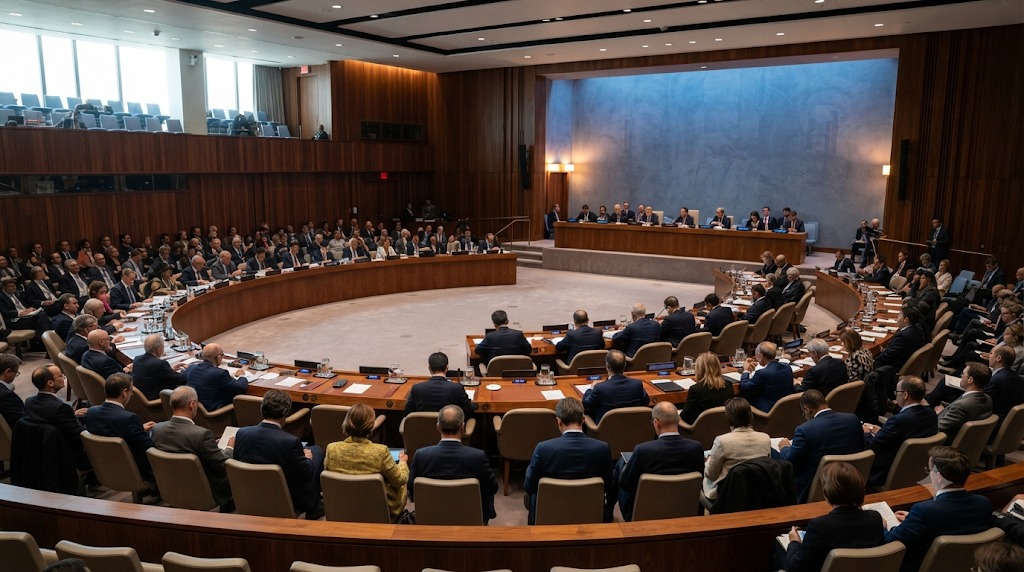
Which of the following bodies is the sole organ of the United Nations possessing the authority to issue binding resolutions that member states must implement?
- United Nations General Assembly
- International Court of Justice
- United Nations Security Council
- United Nations Economic and Social Council
Practice questions are answered inside your account. Create a free account, or see what practice includes.
Consider the following statements regarding the United Nations Security Council: It was established in 1945 under the UN Charter and held its first session in London. Its permanent headquarters is located in Geneva, Switzerland. Which of the statements given above is/are correct?
- 1 only
- 2 only
- Both 1 and 2
- Neither 1 nor 2
Practice questions are answered inside your account. Create a free account, or see what practice includes.
When peaceful means fail to resolve an international dispute, which of the following enforcement measures can the UN Security Council authorize?
- Economic sanctions and arms embargoes only
- Binding advisory opinions on domestic laws
- Economic sanctions, arms embargoes, financial penalties, travel bans, or collective military action
- Expulsion of member states from the United Nations General Assembly
Practice questions are answered inside your account. Create a free account, or see what practice includes.
What structural feature of the United Nations Security Council ensures that major global powers remain central to any enforceable international security decision?
- Universal representation of all 193 member states
- The presence of five permanent members possessing veto power
- Rotating leadership chosen exclusively by the General Assembly
- A requirement for a unanimous vote among all member states
Practice questions are answered inside your account. Create a free account, or see what practice includes.
Which of the following best describes a primary significance of a UNSC resolution in global diplomacy?
- It provides international legal legitimacy for interventions or sanctions.
- It serves as a binding treaty that automatically amends national constitutions.
- It grants the General Assembly absolute authority over military deployment.
- It replaces domestic legislation in conflict-affected member states.
Practice questions are answered inside your account. Create a free account, or see what practice includes.