Ru-Soam Engineering↗
30 Apr 2026
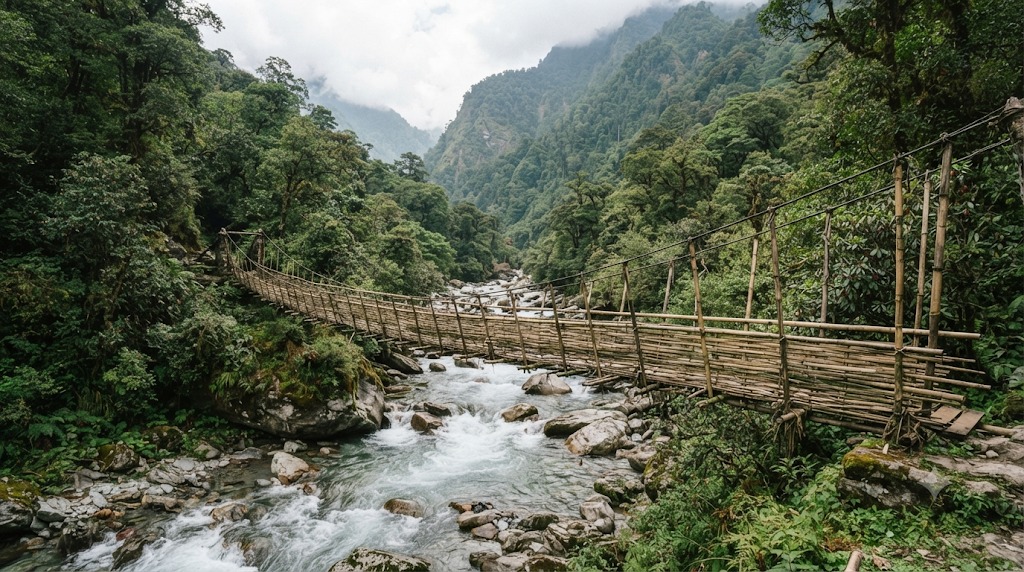
Consider the following statements regarding the Ru-Soam engineering tradition: It refers to the indigenous cane and bamboo footbridges constructed by the Lepcha community. The method originated in the isolated Dzongu area of Sikkim. The bridges entirely rely on carbon-intensive materials like reinforced concrete for anchorage. Which of the statements given above are correct?
- 1 and 2 only
- 2 and 3 only
- 1 and 3 only
- 1, 2 and 3
Practice questions are answered inside your account. Create a free account, or see what practice includes.
In the context of traditional Ru-Soam footbridges, what do the terms 'Soamgyang' and 'Ahool' respectively refer to?
- Bamboo deck and lateral bracing
- Primary parallel cane cables and oscillating suspender loops
- Anchor trees and vertical struts
- Railings and corrosion-resistant coatings
Practice questions are answered inside your account. Create a free account, or see what practice includes.
Consider the following features of the materials used in Ru-Soam engineering: Bamboo varieties such as mahlu and podiyang are utilized for their high tensile strength. The materials have a long regeneration period of over 25 years. Which of the statements given above is/are correct?
- 1 only
- 2 only
- Both 1 and 2
- Neither 1 nor 2
Practice questions are answered inside your account. Create a free account, or see what practice includes.
The traditional Ru-Soam footbridges of Sikkim are primarily located inside which of the following protected areas?
- Nokrek Biosphere Reserve
- Manas National Park
- Khangchendzonga Biosphere Reserve
- Dibru-Saikhowa Biosphere Reserve
Practice questions are answered inside your account. Create a free account, or see what practice includes.