Planning, the Mixed Economy, Land Reforms and the Green Revolution (1947-1990)
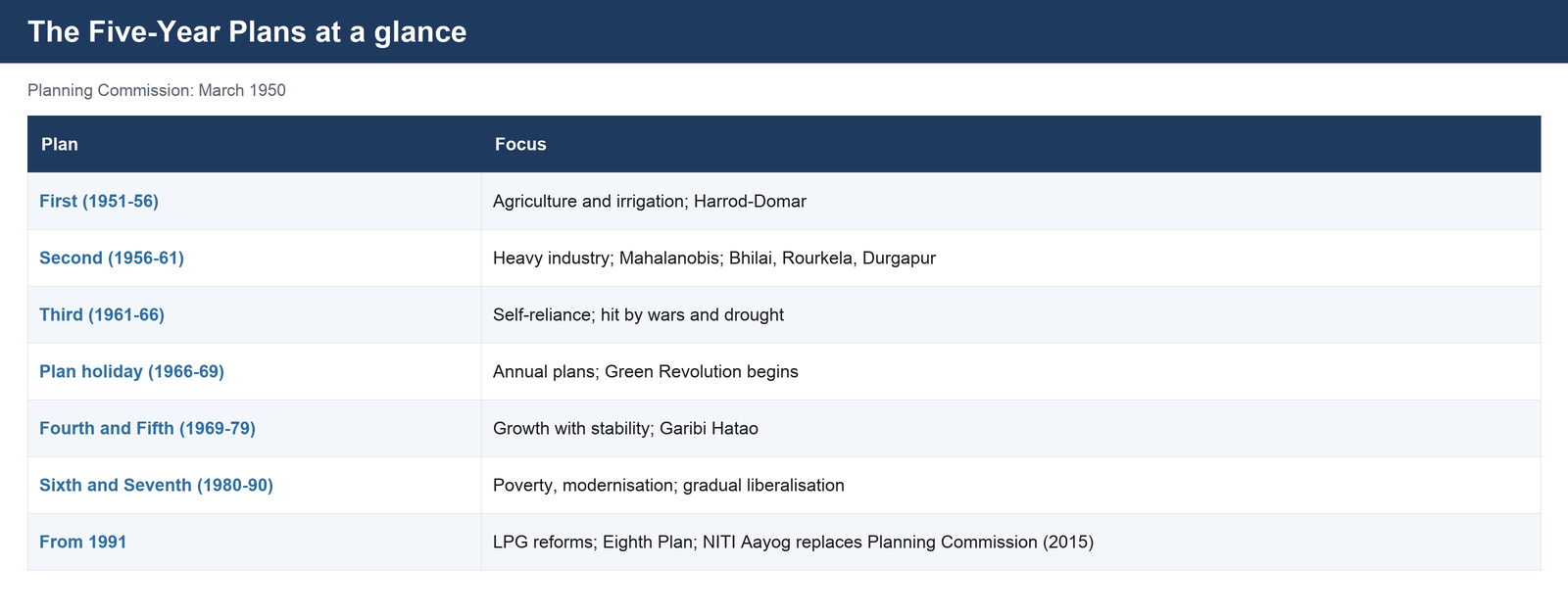
| Plan | Period | Focus and notes |
|---|---|---|
| First | 1951-56 | Agriculture, irrigation and power (Harrod-Domar model); Bhakra-Nangal, Hirakud, Damodar Valley; target 2.1%, achieved about 3.6% |
| Second | 1956-61 | Rapid industrialisation, heavy industry (Mahalanobis model); steel plants at Bhilai, Rourkela, Durgapur |
| Third | 1961-66 | Self-reliant 'take-off'; affected by the China and Pakistan wars and droughts |
| Plan holiday | 1966-69 | Three annual plans |
| Fourth | 1969-74 | Growth with stability and self-reliance |
| Fifth | 1974-79 | Garibi Hatao; ended in 1978 (Janata government's Rolling Plan) |
| Sixth | 1980-85 | Poverty alleviation; modernisation; the 1980 Industrial Policy |
| Seventh | 1985-90 | Food, work, productivity |
| Eighth | 1992-97 | Began after the 1991 reforms (indicative planning) |
The Second Five-Year Plan focused on
- Heavy industry
- Agriculture
- Poverty alleviation
- Services
Practice questions are answered inside your account. Create a free account, or see what practice includes.
The Green Revolution began in India in
- 1966-67
- 1951
- 1980
- 1991
Practice questions are answered inside your account. Create a free account, or see what practice includes.
Operation Flood was associated with
- Milk
- Wheat
- Rice
- Cotton
Practice questions are answered inside your account. Create a free account, or see what practice includes.
The Nagarjuna Sagar dam is built on the river
- Krishna
- Godavari
- Tungabhadra
- Penna
Practice questions are answered inside your account. Create a free account, or see what practice includes.
The Industrial Policy Resolution of 1956 gave the central role to the
- Public sector
- Private sector
- Foreign capital
- Cooperatives only
Practice questions are answered inside your account. Create a free account, or see what practice includes.