Module 1 · Lesson 2 of 23 min read
Money Supply, Reserve Money and the Money Multiplier
Figure: monetary aggregates
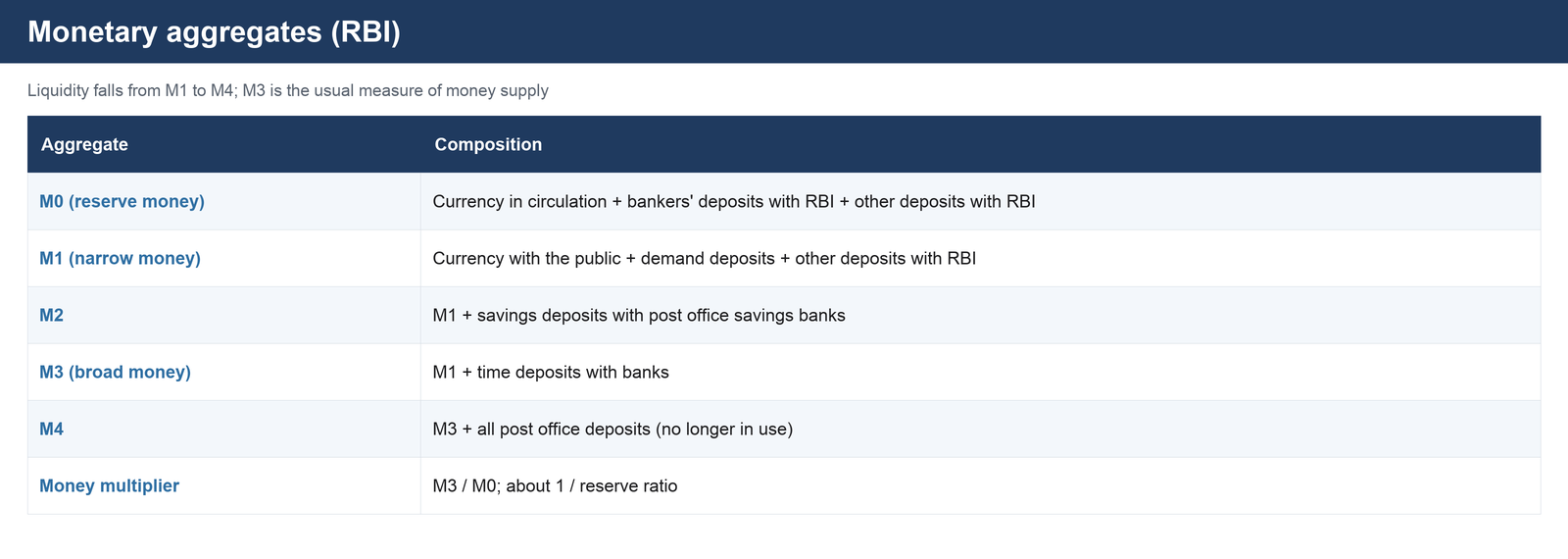
| Aggregate | Composition | Liquidity |
|---|---|---|
| M0 (reserve money) | Currency in circulation + bankers' deposits with RBI + other deposits with RBI | Base |
| M1 | Currency with public + demand deposits + other deposits with RBI | Highest |
| M2 | M1 + post office savings bank deposits | High |
| M3 | M1 + time deposits with banks | Lower (broad money) |
| M4 | M3 + total post office deposits | Lowest |
Practice question
Which of the following is the most liquid?
- M1
- M2
- M3
- M4
Practice questions are answered inside your account. Create a free account, or see what practice includes.
Practice question
High-powered money is another name for
- Reserve money
- Broad money
- Near money
- Bank money
Practice questions are answered inside your account. Create a free account, or see what practice includes.
Practice question
M3 includes
- M1 plus time deposits with banks
- M1 plus post office deposits
- Only currency
- Only demand deposits
Practice questions are answered inside your account. Create a free account, or see what practice includes.
Practice question
If the CRR is lowered, the money multiplier
- Increases
- Decreases
- Remains unchanged
- Becomes zero
Practice questions are answered inside your account. Create a free account, or see what practice includes.
Practice question
The Market Stabilisation Scheme is used for
- Absorbing surplus liquidity
- Raising taxes
- Issuing currency
- Funding the budget
Practice questions are answered inside your account. Create a free account, or see what practice includes.