The NITI Aayog Releases Future Of India’s Semiconductor Industry Roadmap
30 May 2026
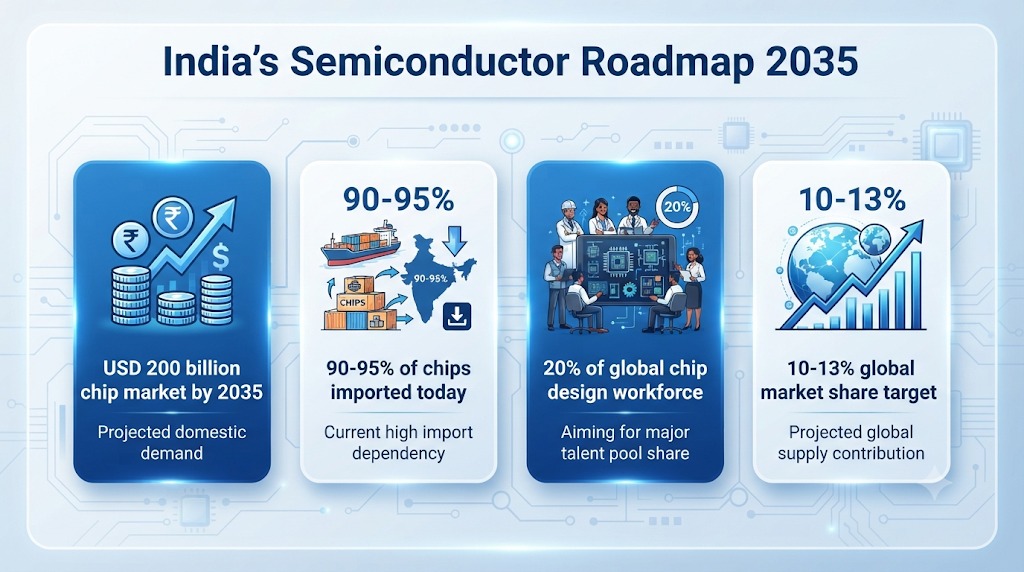
With reference to the strategic roadmap 'Future of India’s Semiconductor Industry' released by NITI Aayog, consider the following statements: It aims to establish a domestic semiconductor value chain valued at USD 120–150 billion by the year 2035. The roadmap prioritizes direct competition in the sub-2nm global wafer race over specialized mature logic nodes and advanced packaging. India currently houses approximately 20% of the worldwide semiconductor design workforce. Which of the statements given above are correct?
- 1 and 2 only
- 1 and 3 only
- 2 and 3 only
- 1, 2 and 3
Practice questions are answered inside your account. Create a free account, or see what practice includes.
Consider the following targets and financial projections outlined in NITI Aayog’s 2035 semiconductor roadmap: Cumulative import expenditure on semiconductors between FY17 and FY25 reached nearly USD 150 billion. India aims to secure 10–13% of the total global semiconductor market share by 2035. The estimated growth capital investment required over the upcoming decade is between USD 45–60 billion. Which of the statements given above are correct?
- 1 and 2 only
- 2 and 3 only
- 1 and 3 only
- 1, 2 and 3
Practice questions are answered inside your account. Create a free account, or see what practice includes.
Which of the following best describes the core strategic focus of the 'More-than-Moore' approach advocated in NITI Aayog’s semiconductor roadmap?
- Subsidizing foreign firms to relocate their existing sub-2nm fabrication units directly into Indian metropolitan zones
- Achieving deep manufacturing strength in mature logic nodes, specialized wide-bandgap compound materials, and advanced OSAT packaging
- Focusing exclusively on software design IPs while outsourcing all physical assembly and packaging operations abroad
- Restricting chip production strictly to legacy consumer electronics without entering automotive or defense sectors
Practice questions are answered inside your account. Create a free account, or see what practice includes.
With regard to the challenges and policy recommendations identified in the NITI Aayog semiconductor report, consider the following statements: Establishing specialized National Semiconductor Zones (NSZs) is proposed to address heavy utility demands, utilizing on-site small modular nuclear reactors and six-nines utility reliability. The roadmap notes that a modern analog fab costs over USD 5 billion, while a leading-edge 3nm wafer facility exceeds USD 15 billion. Which of the statements given above is/are correct?
- 1 only
- 2 only
- Both 1 and 2
- Neither 1 nor 2
Practice questions are answered inside your account. Create a free account, or see what practice includes.